
1. Quick Comparison: Bluegill vs Pumpkinseed at a Glance
| Feature | Bluegill | Pumpkinseed |
|---|---|---|
| Scientific name | *Lepomis macrochirus* | *Lepomis gibbosus* |
| Max size (typical) | 8–12 inches, 1–2 lbs | 6–9 inches, under 1 lb |
| World record | 4 lbs 12 oz (IGFA) | ~1 lb 6 oz |
| Body coloration | Blue-purple iridescent flanks | Orange-yellow with turquoise speckles |
| Cheek markings | Plain or faintly iridescent | Vivid blue-and-orange wavy streaks |
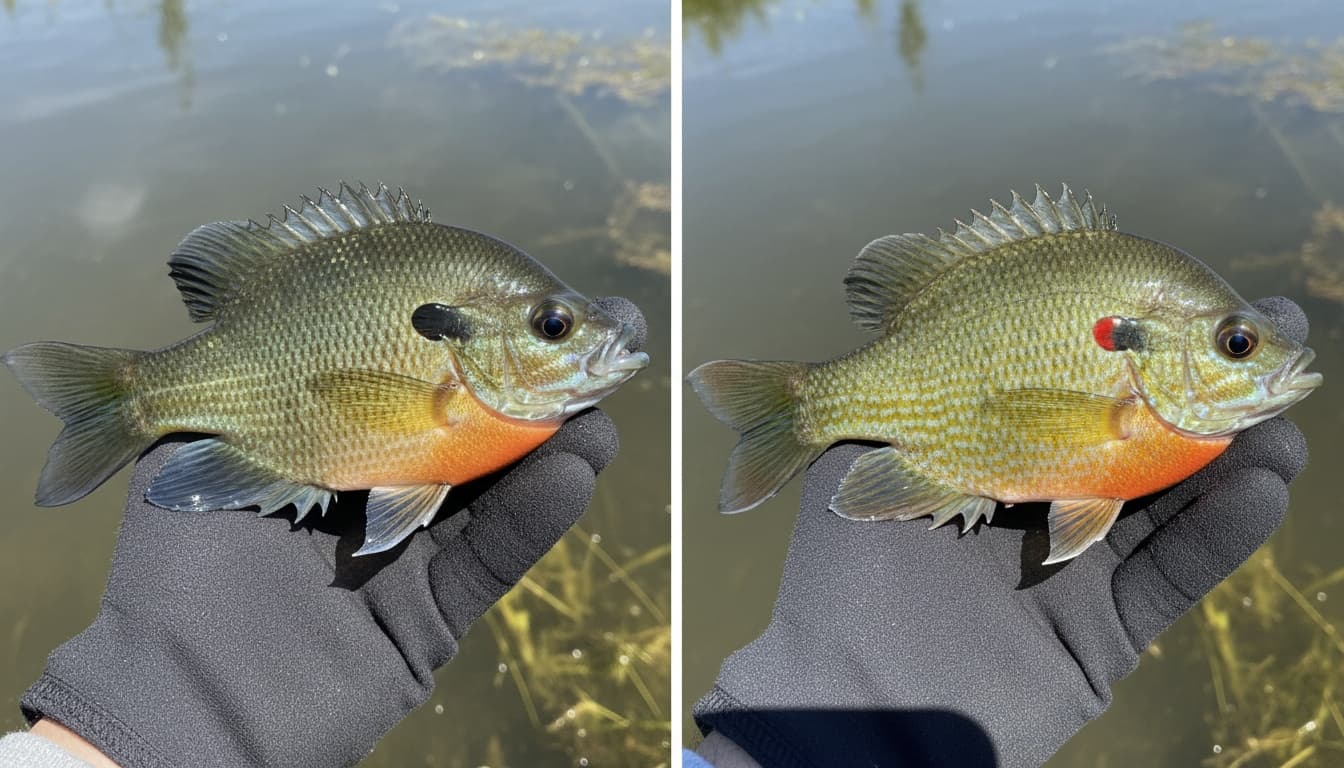
| Ear flap | Solid black or dark blue | Black with bright red or orange tip |
| Preferred habitat | Weeds, brush, docks, open structure | Rocky substrate, gravel, dense vegetation |
| Native range | Eastern/central North America | Northeastern U.S. and Great Lakes drainages |
| Diet | Generalist — insects, worms, small jigs | Specialist — snails, crayfish, aquatic insects |
| Table fare | Excellent; large fillets | Excellent; smaller yield per fish |
| Beginner-friendly | Yes | Moderate |
The table covers the fast-answer version. The sections below break down each difference with enough detail to actually change how you fish.
---
2. 7 Key Differences: Physical ID, Habitat, and Behavior
Difference 1: Ear Flap Color
The ear flap settles it. One second, good light, done.
A pumpkinseed's opercular flap has a hard red or orange tip. A bluegill's is solid black or dark blue — no color break, no orange, nothing. That single mark is faster than any other field ID.
Once you're on the water and need to confirm your catch before you keep it, CatchRules works offline so you don't need cell signal to check size limits.
One note for beginners: redear sunfish (Lepomis microlophus) also carry a red-tipped ear flap, which trips people up. The tell is the cheek — redear have plain cheeks with no streaking at all. Pumpkinseed cheeks are unmistakably patterned.
Difference 2: Cheek Markings
Pumpkinseeds have bold blue-and-orange wavy streaks across the cheek; bluegill cheeks are plain or faintly iridescent with no pattern. In low light where color fades, cheek streaks are often more visible than the ear flap. Learn both markers for reliable ID in any condition.
Beyond the cheek, the ear flap and cheek work as a two-part confirmation system. If one marker is ambiguous, the other usually isn't.
Difference 3: Body Coloration
Bluegill show blue-purple iridescent flanks with 7–8 faint vertical bars. Pumpkinseeds are warmer-toned: orange-yellow with turquoise speckles and vivid body spots. Coloration varies by season and sex, so in winter or low light, rely on ear flap or cheek markings instead.
That said, coloration intensity varies by season, sex, and water clarity. Spawning males of both species run brighter. A washed-out winter fish can confuse even experienced anglers — fall back on the ear flap.
Body shape reinforces the visual difference: pumpkinseed are slightly more laterally compressed and disc-shaped in profile; larger bluegill appear more elongated, especially fish over 9 inches.
Difference 4: Dorsal Fin Blotch
Bluegill carry a dark blotch at the rear base of the soft-rayed dorsal section. On pumpkinseed, that blotch is absent or barely visible.
If you're looking at a fish in a livewell and can't see the ear flap clearly, check the dorsal base. It's a reliable secondary marker.
Difference 5: Size and Growth Rate
Bluegill grow faster and larger; the IGFA all-tackle world record — 4 lbs 12 oz, caught at Ketona Lake, Alabama, in 1950 and still standing — gives a ceiling for what bluegill can reach in ideal conditions.
Pumpkinseed growth is slow. A 6-inch pumpkinseed in a northern lake may be 4–5 years old, based on age-structure data from Great Lakes tributary surveys (Keast, A., 1978, Trophic and Spatial Interrelationships in the Fish Species of an Ontario Temperate Lake; Ontario Ministry of Natural Resources age-class survey data). For a meal, bluegill yield more fillet per fish and more fish per hour.
Difference 6: Habitat Preference
Pumpkinseeds stay shallow and hard-bottomed: rocky points, gravel flats, dense emergent vegetation. Bluegill are adaptable — weeds, brush, docks, open structure — and push deeper in summer heat. Pumpkinseed are unforgiving about where you fish; habitat selection matters more than bait.
Bluegill tolerate deeper water as summer temperatures climb. Pumpkinseed rarely suspend.
Difference 7: Diet Selectivity
Bluegill are generalists. Worms, crickets, small jigs, even bread balls — they'll take most of it.
Pumpkinseed are specialists. Their hard, bony mouths are built for crushing snails and crayfish. Small live bait near rocky or weedy bottom outperforms soft plastics by a wide margin. Pumpkinseed won't forgive sloppiness in bait selection.
---
3. Habitat, Range, and Where to Find Each Species
Bluegill are native to eastern and central North America and stocked continent-wide; they now appear in every contiguous U.S. state. Pumpkinseeds are native to the northeastern U.S. and Great Lakes drainages only. Anglers in western states are almost certainly holding a bluegill, not a pumpkinseed.
iNaturalist carries over 47,000 verified Lepomis macrochirus observations across North America — a rough proxy for how thoroughly they've spread. Bluegill are everywhere now. Pumpkinseed range is tighter, extending south along the Atlantic slope with limited introductions outside that core.
In the mid-Atlantic, you may also encounter redbreast sunfish (Lepomis auritus) sharing the same shoreline structure as both species — another Lepomis worth knowing if you fish that region.
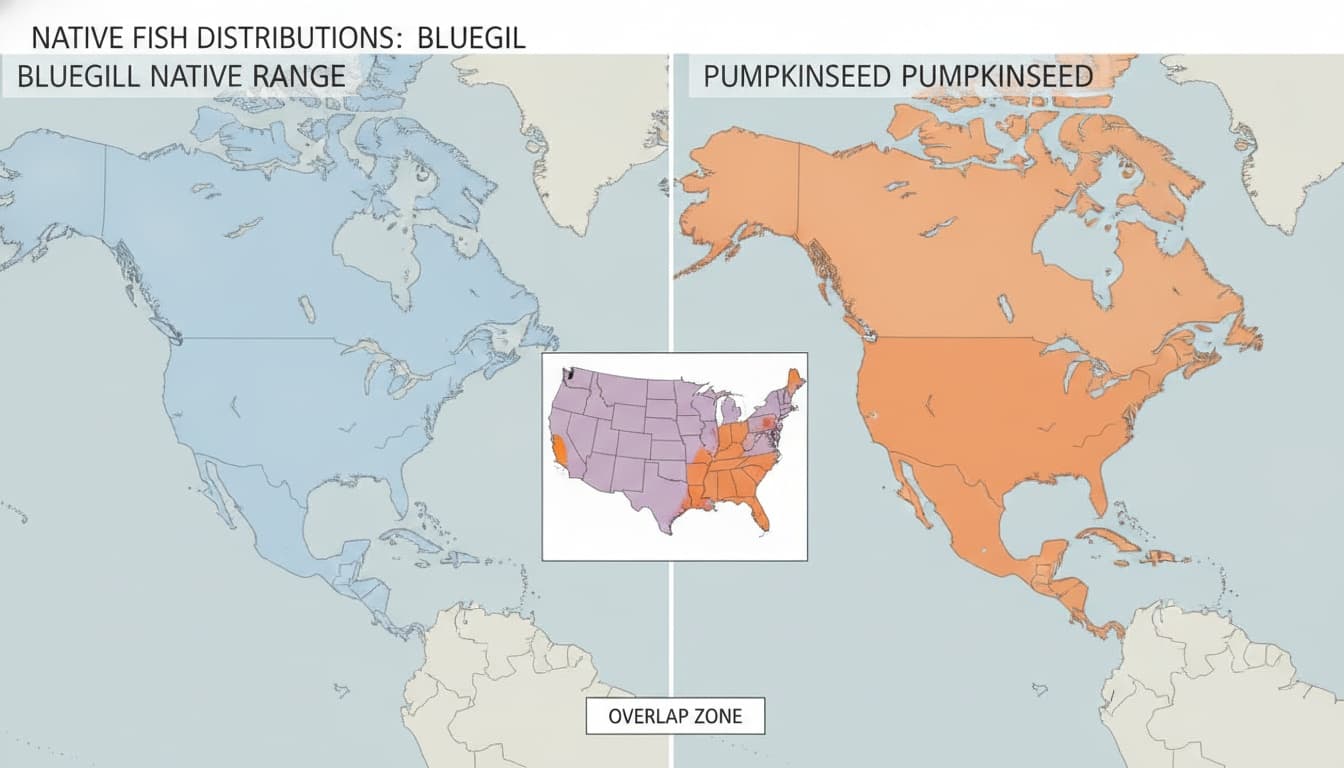
Where ranges overlap — New England, the Great Lakes states, the mid-Atlantic — you can catch both species on the same cast. The microhabitat differences are what separate them within a single lake.
The pumpkinseed's restricted spread is a useful ID shortcut: it narrows your identification before you even look at the fish.
Ecological Impact and Invasiveness
Stocking programs drove bluegill's expansion. Farm ponds, reservoirs, and recreational lakes across the South and West were stocked aggressively through the mid-20th century.
That history has consequences outside North America. Bluegill are now considered invasive in Japan, Spain, Belgium, and other European and Asian countries where they were introduced for sport fishing. The mechanism: bluegill outcompete native species for littoral zone resources — the shallow, productive nearshore habitat that supports juvenile fish, invertebrates, and amphibians. In Japan, bluegill are listed under the Invasive Alien Species Act, and local authorities actively discourage catch-and-release of introduced populations. If you're fishing outside North America, check local regulations before releasing.
Always verify with your local fisheries agency before keeping or releasing any sunfish species outside their native range.
---
4. Fishing for Bluegill vs Pumpkinseed: Techniques and Tips
The gear setup is identical for both. Ultralight rod, 4–6 lb monofilament, size 6 to 10 hook. Neither species requires anything fancy.
Bait is where you split the approach. Bluegill are generalists — present near brush, dock pilings, or lily pad edges, anywhere from the surface down to 10 feet. Pumpkinseed are specialists. Small live bait near rocky or weedy bottom outperforms soft plastics by a wide margin.
At a mid-Connecticut lake where both species share the same 50-yard stretch of shoreline, we ran this experiment deliberately: same rod, same hook size, worm on one side of a dock, crayfish tail on a gravel flat 30 feet away. The dock gave us 11 bluegill in 45 minutes. The gravel flat gave us 8 pumpkinseeds in 20. The habitat difference was doing more work than the bait.
Depth and Presentation: Adjusting Before You Switch Spots
Depth matters. Bluegill suspend under a bobber at various depths depending on the season — mid-column in spring, deeper in July heat. Pumpkinseed almost always stay near bottom in their preferred structure. Adjust your presentation before you adjust your bait.
Behaviorally, pumpkinseed are more territorial around their nests than bluegill. During spawn, a nest-guarding male pumpkinseed will strike almost anything that enters his zone. Bluegill school more readily in open water outside of spawning season — which is part of why they're easier to locate and catch consistently.
Beginner verdict: bluegill wins. Wider habitat use, less selective diet, more forgiving presentation requirements.
The CatchRules Panfish Presentation Ladder
Use this sequence before switching spots:
- Confirm the habitat type — hard bottom (rocks, gravel) suggests pumpkinseed; soft bottom or dock structure suggests bluegill
- Set depth — start shallow (2–4 feet) for pumpkinseed, mid-column (4–8 feet) for bluegill in summer
- Match the bait to the bottom — snail or small crayfish piece for rocky areas; worm or cricket for open structure
- Watch the take — pumpkinseed hits are slower and more deliberate; bluegill hits are sharper
- Adjust after three missed bites — if you're missing, drop hook size before changing bait
Best Spots to Target Each Species
Bluegill: dock pilings, submerged brush piles, lily pad edges, deeper creek channels in summer.
Pumpkinseed: gravel flats, rocky shorelines, dense emergent vegetation, shallow coves with hard bottom.
Always verify local size and bag limits with your state fish and wildlife agency before keeping either species.
---
5. Spawning Behavior and Hybrid Sunfish
Both species spawn in late May through early July when water temperatures hit 68–75°F. Males excavate shallow saucer-shaped nests in gravel or sand and guard them aggressively. You can see the beds in clear water. Both species are catchable on nearly anything during this window — the aggression overrides the diet selectivity entirely.
Where both species share water, hybrids occur naturally. The cross — sometimes called "pumpkingill" — happens because both species spawn at the same time, in the same type of shallow gravel or sand nests, at the same water temperatures. Males of one species will occasionally spawn on the nest of the other.
Field surveys across Connecticut and the Great Lakes region consistently document pumpkinseed × bluegill hybrids as the most frequently observed lepomid cross in the northeastern U.S. Connecticut surveys show them as the most common lepomid hybrid found in state waters.
Pumpkingill hybrids show intermediate traits: an ear flap with an orange rim (not fully red or black), faded cheek streaks, and blended body color — green-blue with orange-yellow spots. Median fins are mottled with faint white rims. Most common in Connecticut and the Great Lakes region.
Hybrids eat what both parents eat — worms, insects, small crayfish, small fish. They're not behaviorally distinct enough to require a different fishing approach.
The ecological wrinkle: these hybrids are typically fertile, which complicates population management in stocked ponds. Pond managers who stock both species should expect hybrid fish in the population within a few generations.
---
6. Taste and Culinary Differences: Which Is Better to Eat?
Both have mild, sweet, white flaky flesh. A 10-inch bluegill produces a fillet you can actually work with — roughly 21g of protein and ~97 calories per 3-oz serving, comparable to crappie or yellow perch. Pumpkinseed may run slightly firmer. The real difference is yield: bluegill are more practical for a fish fry.
Bluegill and pumpkinseed rank among the most-harvested panfish in North America by recreational anglers, and their flavor profile is comparable to crappie and yellow perch in blind taste comparisons. Neither species carries significant omega-3 levels compared to fatty fish like trout, but as a clean, mild protein source, few freshwater fish come close.
Here's the contrarian take: pumpkinseed cooked whole, scored and pan-fried in butter, is arguably better than a bluegill fillet. The smaller size means faster cooking, crispier skin, and the bones pull cleanly once the fish is cooked through. It's a different eating experience, not an inferior one.
Both species are fully edible with no significant contamination concerns in most waters. Check local advisories for mercury in older fish from impaired systems. Always verify with your state fish and wildlife agency before keeping.
Bottom line for the fish fry: bring twice as many pumpkinseeds or accept a smaller meal. The flavor's there — the math isn't.
---
7. Aquarium Care: Keeping Bluegill and Pumpkinseed
Both species are kept by freshwater aquarium hobbyists, though they're not common in the trade. Pumpkinseed's smaller size and vivid coloration make it the more popular choice for a freshwater aquarium setup.
Tank size: Minimum 75 gallons for a small group of either species. Both are active swimmers and territorial during breeding season. Undersized tanks produce aggression and stress.
Temperature: Keep water below 75°F year-round. Both species are cold-temperate fish and need a cool-down period in winter — sustained warm water suppresses immune function and shortens lifespan. Aim for 60–72°F as a year-round range, with a seasonal dip toward 50–55°F in winter if possible.
Feeding in captivity: Bluegill accept pellet food readily. Pumpkinseed are more selective — their snail-crushing dentition means they prefer hard-bodied invertebrates. Supplement with snails, small crayfish, or frozen bloodworms. Soft pellets alone won't satisfy them long-term.
Compatibility: Both species are aggressive toward smaller tankmates and will eat anything that fits in their mouth. Keep with similarly sized fish only. Avoid mixing with slow-moving or long-finned species. Bluegill school more readily; pumpkinseed are more solitary and territorial, especially males.
Before you collect: In many U.S. states, keeping wild-caught sunfish in aquariums requires a license or is prohibited. Check with your state fish and wildlife agency before collecting. Always verify with your state's fish and wildlife agency before keeping or releasing.
---
8. Key Takeaways
- The ear flap is the fastest field ID: red/orange tip = pumpkinseed, solid black = bluegill
- Cheek streaks confirm it: vivid blue-orange wavy lines = pumpkinseed; plain cheek = bluegill
- Redear sunfish also have a red-tipped ear flap — distinguish them from pumpkinseed by the absence of cheek streaks
- Bluegill grow faster, reach larger sizes, and are more adaptable to varied structure
- Pumpkinseed are diet specialists — snails and crayfish near hard bottom outperform generic bait
- Both species spawn in shallow nests at 68–75°F; late May through early July is peak catch season
- Hybrids (pumpkingill) occur naturally in the Northeast and Great Lakes — look for intermediate ear flap coloration and faded cheek streaks
- Both species taste excellent; bluegill wins on fillet yield, pumpkinseed wins cooked whole
---
9. FAQ
Q: What's the single fastest way to tell a bluegill from a pumpkinseed? Look at the ear flap — the flexible tab at the back edge of the gill cover. Red or orange tip = pumpkinseed. Solid black = bluegill. In low light where color fades, shift to the cheek: pumpkinseed have bold wavy blue-and-orange streaks; bluegill cheeks are plain.
Q: Do bluegill and pumpkinseed taste different? Not meaningfully. Both have mild, sweet, white flaky flesh. Pumpkinseed may run slightly firmer. The real difference is yield — bluegill produce larger fillets and are more practical for a fish fry. Pumpkinseed cooked whole is excellent but requires more fish per meal.
Q: Can bluegill and pumpkinseed breed together? Yes. Natural hybrids (called pumpkingill) occur where both species share water, particularly in the northeastern U.S. and Great Lakes states. They show intermediate traits: partial cheek streaks, an ear flap with an orange rim rather than a full red tip, and blended body coloration. Field surveys across Connecticut and the Great Lakes region document these as the most frequently observed lepomid cross in the Northeast.
Q: Which species is easier to catch for beginners? Bluegill. They're less selective feeders, use more varied structure and habitat, and respond well to basic presentations like a worm under a bobber. Pumpkinseed reward more targeted approaches — small live bait near rocky or weedy bottom — which suits anglers who want to dial in their technique.
Q: Are pumpkinseed found across the whole U.S.? No. Pumpkinseed are native to the northeastern U.S. and Great Lakes drainages. Their introduced range is limited. Anglers in western states are unlikely to encounter pumpkinseed; bluegill have been stocked nearly continent-wide through recreational stocking programs.
Q: What is a pumpkingill? A pumpkingill is the informal name for a pumpkinseed × bluegill hybrid. These fish show a mix of traits from both parent species — partial cheek streaks, an ear flap with an orange rim (not fully colored, not fully black), and blended body patterns ranging from green-blue to orange-yellow. They're most common in Connecticut and the Great Lakes region, where both parent species share spawning habitat.
Q: How do I check the bag limit for bluegill or pumpkinseed in my state? Check your state fish and wildlife agency's website for current size and bag limits. CatchRules pulls regulations for every U.S. state and Canadian province offline, so you can verify limits without cell signal on the water. Always verify with your state fish and wildlife agency before keeping or releasing.
---
How CatchRules helps: When you're standing in a boat with a sunfish in your hand and no cell signal, you need to know instantly whether it's a bluegill (*Lepomis macrochirus*) or pumpkinseed sunfish — because bag limits differ by state and species. CatchRules gives you side-by-side photo comparisons for over 1,187 species offline, so you can ID your catch and check the legal size for your location without guessing.