
1. Walleye vs. Sauger at a Glance: Identify in 30 Seconds
| Feature | Walleye | Sauger | Saugeye (hybrid) |
|---|---|---|---|
| **Max common size** | 10+ lbs | 2–3 lbs | 4–6 lbs |
| **Coloration** | Golden-brown, brassy flanks | Gray to olive, dark blotches | Mixed — often mottled |
| **Dorsal fin** | Solid black patch, no spots | Rows of distinct spots | Usually spotted |
| **Tail tip** | White spot on lower lobe | No white tip | Variable |
| **Range** | Great Lakes, northern U.S., Canada | Mississippi/Missouri river systems | Stocked reservoirs |
| **Habitat** | Clear lakes, rocky structure | Turbid rivers, tailwaters | Reservoirs, murky water |
| **World record** | 25 lbs (Greers Ferry Lake, AR, 1982) | 8 lbs 12 oz (Lake Sakakawea, ND) | Not tracked separately |
| **Taste** | Firm, white, mild | Nearly identical | Nearly identical |
The saugeye is the hybrid offspring of a male sauger and a female walleye — more on that in the behavioral section below.
---
2. Physical Differences: How to Tell Them Apart
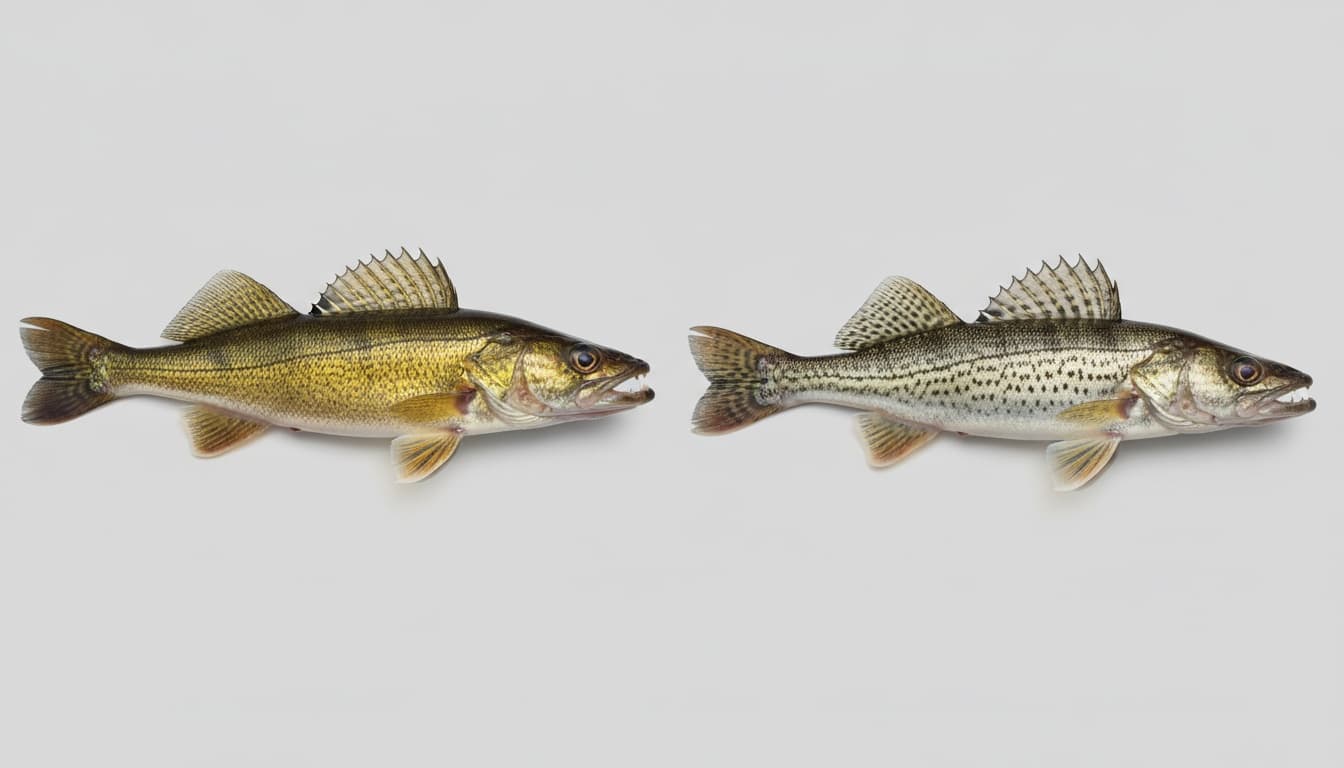
Start with color. Walleye flash that signature golden-brown with brassy flanks — clean, almost metallic in good light. Sauger look duller: gray to olive-brown, with dark saddle-like blotches running the length of the body. Dull is the right word — in a river with any stain to it, a sauger can look almost black, and a walleye pulled from tannic water can look surprisingly dark.
That rule breaks in stained water, which is why color alone will get you in trouble. Always confirm with the fin.
Dorsal Fin: The Single Check That Resolves 90% of Walleye vs. Sauger Confusion
Sauger have distinct spots arranged in rows along their entire dorsal fin. Walleye have zero spots — a solid black patch sits on the membrane between the last two or three spines instead. Wyoming Game and Fish confirms: "Saugers have distinct spots along their entire dorsal fin, whereas walleyes have no spots but do have a black patch on the membrane between the last two or three spines."
Fin ray counts (11–13 walleye, 11–12 sauger) overlap too much to be reliable. Stick with the spotted dorsal vs. black patch rule.
The White Tail Tip
That bright white spot on the lower lobe of the caudal fin belongs to walleye. No white tip at all? You're holding a sauger. Midwest Outdoors confirms walleye have a large white spot on the bottom of the tail; sauger have none.
Coloration and Body Markings
Sauger carry dark, mottled coloration — gray to olive-brown with saddle-like blotches running the full body length. Walleye flash golden-brown with brassy, almost metallic flanks. But water stain, season, and lighting can make a walleye look surprisingly dark in tannic river water. Use coloration as a starting point, never a conclusion.
After pulling fish from the Illinois River in late October, we've seen walleye that looked almost brown enough to pass for sauger until we checked the fin. Coloration is a starting point. Never a conclusion.
Wyoming Game and Fish confirms that sauger carry dark, mottled coloration along the entire body length, while walleye do not.
Why Eye Reflectivity Doesn't Help
Both species have the tapetum lucidum — the reflective layer behind the retina that produces the famous "candlelight eyes" glow in low light. Eye reflectivity is dramatic in both fish. It's also completely useless for telling them apart. Don't bother.
---
3. How Large Do Walleye and Sauger Grow?
Average walleye run 1–3 lbs on most waters, with fish to 10 lbs common in prime fisheries. The world record — 25 lbs, caught at Greers Ferry Lake, Arkansas, in 1982 — still stands.
Sauger are a different story entirely. Most fish run 0.5–1.5 lbs. The Wisconsin state record is 6 lbs 6.7 oz, taken from the Mississippi River in Pierce County on March 19, 2009, according to Midwest Outdoors. Minnesota's state record is 6 lbs 2 oz, also from the Mississippi.
That framing undersells sauger. Their smaller average size is a feature for some anglers, not a drawback. In winter tailwaters, schooled sauger in the 13–15 inch range produce fast, consistent action that trophy-hunting walleye anglers miss entirely. Midwest Outdoors reports that most sauger at Lake of the Woods run 13–15 inches; the Mississippi River regularly produces fish at 16–17 inches.
Saugeye can outgrow sauger by a measurable margin — stocked saugeye in managed reservoirs have shown faster growth rates than pure sauger in comparable systems. Still, they rarely match pure walleye size at the top end. Knowing where each species lives is half the battle. The other half is understanding when and how they feed — and that's where sauger's reputation as the "other walleye" starts to break down.
---
4. Where Do Walleye and Sauger Live?
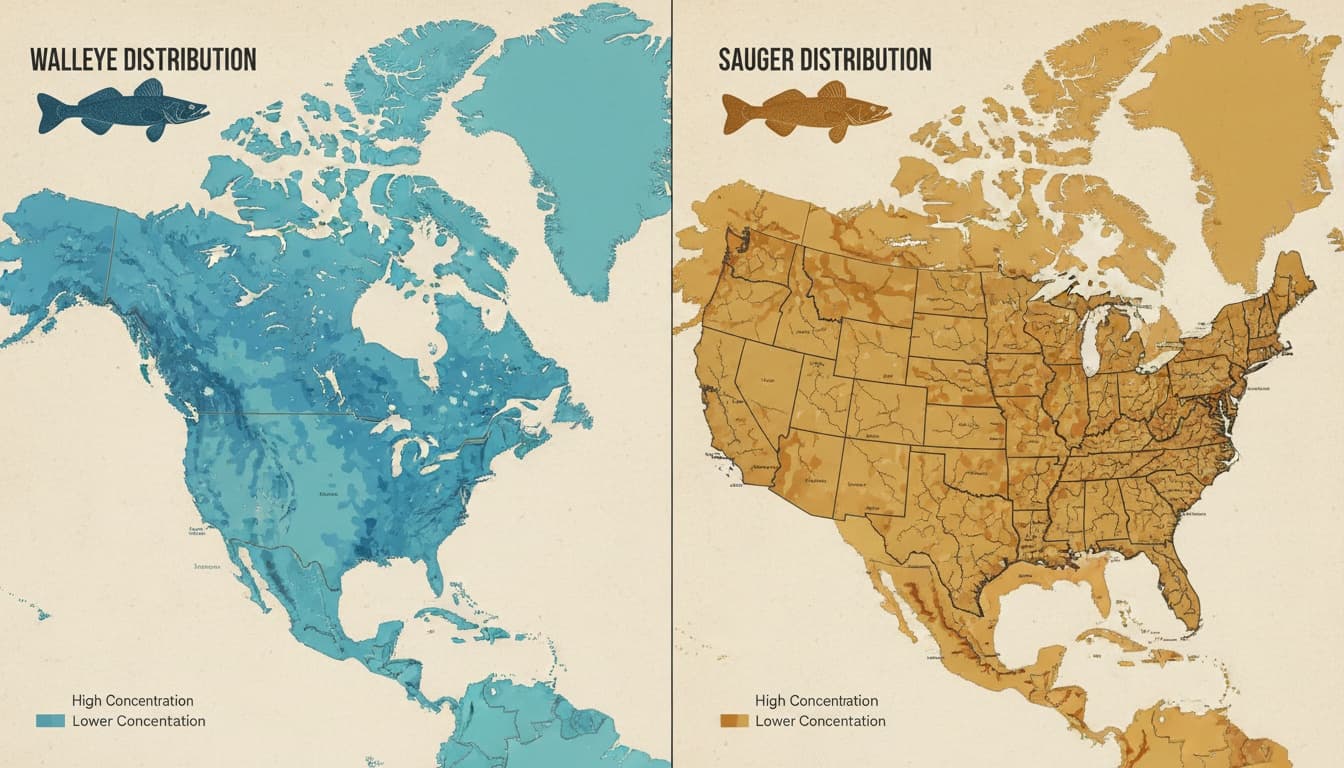
Walleye range covers the Great Lakes, the entire Mississippi River drainage, and most of northern U.S. and Canada. They've been stocked so widely that you'll find them in reservoirs from Nebraska to Tennessee. Lake of the Woods, straddling the Minnesota-Ontario border, is the benchmark destination for serious walleye anglers — consistently ranked among North America's top walleye fisheries by guides and tournament anglers alike.
In contrast, sauger occupy a more restricted range, according to Midwest Outdoors. Their core territory runs through the Mississippi and Missouri River systems, the Illinois River, and lower Great Lakes tributaries. They're rarely stocked compared to walleye, which partly explains why most anglers underestimate how common they actually are in the right river systems.
Habitat preference splits the two species clearly. Walleye want clear, cool lakes and reservoirs with rocky structure and moderate depth. Sauger are built for turbid, fast-moving water — they thrive in river current and silty tailwaters where walleye go inactive. That turbidity tolerance is exactly why fisheries managers stock saugeye in murky reservoirs.
Both species move shallow to spawn in early spring over rocky or gravel substrate, then push deeper through summer. Sauger tend to stay in river channels year-round rather than making the seasonal lake-to-tributary migrations walleye are known for.
---
5. How Do Walleye and Sauger Behave Differently?
Low-light feeding is the one behavior they share. Dawn and dusk, and any overcast day in between — that's when both species feed most aggressively. The tapetum lucidum gives them a visual edge in dim conditions that prey species simply don't have.
But feeding patterns diverge in turbid conditions. Sauger stay active in murky, silty water where walleye often shut down. In strong river current, sauger also rely more heavily on invertebrates than walleye do — they're not strictly fish-chasers.
Spawning timing is close but not identical. Both spawn in early spring over rocky substrate. The overlap is significant enough that you'll encounter both species in the same tailwater stretch during the same week in March.
What Two Fish Make a Saugeye?
A saugeye is the hybrid offspring of a male sauger crossed with a female walleye. Saugeye inherit the spotted dorsal fin from the sauger parent and larger body potential from the walleye side. State agencies stock saugeye in reservoirs because they handle turbid water better than pure walleye — up to 25 lbs vs. a sauger's 3 lbs average at the top end.
The Wisconsin DNR ran a sauger stocking program in the Winnebago system from 2002 to 2012 to rebuild a population that had crashed so severely in the 1990s that a complete harvest ban was necessary, according to Midwest Outdoors. The Winnebago sauger population remains under a restricted bag limit; always verify with the Wisconsin Department of Natural Resources before keeping or releasing.
---
6. The CatchRules 4-Point Fin-and-Body ID Check
We built this after a March morning on Pool 9 of the Mississippi near Lynxville, Wisconsin, where we watched three different anglers release sauger as short walleye — fish that were perfectly legal to keep and would have eaten well. One guy had six of them back in the water before we said anything. Six meals left on the dock because of a 30-second ID mistake.
All of that behavioral context matters for finding fish — but you still need to identify what you've caught before you keep it.
The CatchRules Fin-and-Body ID Check:
- Dorsal fin first — Spots across the fin = sauger. Solid black patch at the base, no spots = walleye. This single check resolves 90% of walleye identification questions.
- Tail tip — White spot on the lower caudal lobe = walleye. No white tip = sauger (or saugeye — check the dorsal again).
- Body color — Dark saddle blotches along the full body length = sauger. Clean golden-brown flanks = walleye. Use as confirmation only; water color distorts this.
- Cheek scales — Run your thumb across the cheek. Rough scales covering the full cheek = sauger. Mostly smooth cheek = walleye. Reliable hands-on check when you're uncertain after steps 1–3.
If you're still unsure after all four checks, you're probably holding a saugeye. Spotted dorsal fin, partial white tail tip, mottled-but-not-fully-blotched body — that's the hybrid signature. See the saugeye identification guide for side-by-side hybrid ID photos.
---
7. Fishing Techniques and Culinary Value
Walleye Fishing Tips
Walleye fishing is well-documented. Jigs along rocky points, live bait rigs (the classic Lindy rig with a crawler), crankbaits trolled in open water, slip bobbers near weed edges at night — the playbook is deep and widely shared. Most stocked fisheries have guide services, online reports, and decades of local knowledge available. For more on the species, see the walleye identification and fishing guide in the CatchRules species database.
Sauger Fishing Tips
Sauger fishing demands more river-specific knowledge. Heavier jigs — often ¾ oz to 1 oz — to reach bottom in current, focus on tailwaters below dams, and patience with current seams. For rod setup, a medium-heavy 6'6" to 7' spinning rod with 10–14 lb braid and a 6–8 lb fluorocarbon leader handles most river walleye and sauger situations in current. The learning curve is steeper, and dedicated sauger anglers feel a legitimate sense of ownership over their fishery because of it.
Winter tailwater sauger is the standout opportunity. In January on the Mississippi below Lock and Dam 11, sauger fishing outproduces walleye fishing by a ratio that would surprise most people who've never tried it. When sauger school in deep river holes in January and February, the action can be faster and more consistent than most walleye fishing at the same time of year. Check sauger habitat maps and seasonal patterns for more on timing and location.
Why Sauger Gets Overlooked
Walleye has a marketing advantage that sauger never had. Stocking programs favor walleye — they grow faster in managed lake environments, they're more predictable for recreational fisheries, and they've been the flagship species for Great Lakes and northern reservoir management for decades. Sauger is a river fish in a culture that built its freshwater identity around lakes. That's the real reason most anglers can't tell them apart: they've simply never targeted sauger intentionally.
Taste and Nutrition
Both walleye and sauger rank among the best-eating freshwater fish in North America. Firm, white, mild, flaky flesh with low oiliness — the profile is nearly identical. Walleye fillets run larger and more uniform; sauger fillets are thinner but equally mild. Both fry well, both hold up to baking, and both work in fish tacos without falling apart.
A 3-oz cooked walleye fillet runs roughly 19g protein, 1g fat, and around 100 calories. Sauger is nearly identical in body composition — no meaningful nutritional difference exists between the two. Both are lower in mercury than most predator fish, which matters if you're eating them regularly.
---
8. Ecological Role
Walleye sit near the top of the food web in the clear-water lakes and reservoirs they dominate. They're apex predators in many systems — controlling populations of yellow perch, cisco, and other forage fish. Their removal or decline cascades through the ecosystem, often triggering prey species population explosions.
In turbid river systems, sauger fill an equivalent role. In the Mississippi and Missouri drainages, they're significant predators of small fish and invertebrates in current environments where walleye are less effective. When sauger populations decline — as happened at Boysen Reservoir in Wyoming, driven by dam construction and the siltation that followed, according to Wyoming Game and Fish — a predator disappears that turbid-water prey species have no equivalent replacement for.
---
9. Regulations, Limits, and Conservation
Regulations vary by state and water body. Always verify with your state fish and wildlife agency before keeping any fish.
A few documented examples illustrate the range:
- Mississippi River (Wisconsin/Minnesota border waters — verify current season regulations before fishing):
- Four-fish combined limit for walleye and sauger; 15-inch minimum size for walleye, no size minimum on sauger, according to Midwest Outdoors.
- Always verify with the Wisconsin Department of Natural Resources and Minnesota Department of Natural Resources before fishing.*
- Lake Winnebago system (Wisconsin — verify current regulations before fishing):
- Combined limit is three fish, with only one sauger allowed in the bag, according to Midwest Outdoors.
- Always verify with the Wisconsin Department of Natural Resources before keeping or releasing.*
- Wind River drainage (Wyoming — verify current regulations before fishing):
- Separate limits — two sauger, six walleye; limits are not combined, so an angler can legally possess up to eight fish total, according to Wyoming Game and Fish. Wyoming Game and Fish also requires that fish remain whole until the angler is off the water, and a piece of skin at least one square inch must remain on all fillets while in transit for species identification purposes.
- Always verify with Wyoming Game and Fish Department before keeping or releasing.*
Saugeye stocked by state agencies are typically managed under walleye regulations — but confirm with your state agency, because that isn't universal.
Conservation note: Walleye populations are stable across most of their native range. Sauger populations have declined in several documented river systems, including Boysen Reservoir in Wyoming, due to habitat degradation, dam construction, and siltation, according to Wyoming Game and Fish. In the 1990s, Lake Winnebago sauger numbers dropped low enough to trigger a full harvest moratorium, according to Midwest Outdoors. That history matters — sauger is not federally listed, but localized population stress is real and ongoing in specific systems.
CatchRules pulls current regulations for every U.S. state without requiring a cell signal — useful when you're on the water and need to confirm a limit before keeping a fish.
---
10. How to Verify Your Catch Instantly — Without Cell Signal
When you're holding a fish in one hand and need instant ID confirmation, CatchRules' side-by-side photo comparison eliminates the guesswork — no more releasing legal sauger by mistake. Check your state's current bag limit and size minimum without waiting for cell signal; critical when you're standing in a tailwater in January trying to confirm whether that 14-inch sauger is legal to keep. CatchRules covers over 1,187 species, including both walleye and sauger — the two Percidae members you're most likely to misidentify on a cold river morning.
---
11. FAQ: Walleye vs. Sauger
Is sauger the same as walleye? No. They're separate species within family Percidae. Sauger are smaller, grayer, and have a spotted dorsal fin with no white tail tip. Walleye have a solid black patch at the dorsal fin base, a white tail tip, and grow significantly larger — up to 25 lbs vs. a sauger's 3 lbs average. The walleye species page and sauger identification and behavior guide cover the full ID breakdown with photos.
Which tastes better, walleye or sauger? The difference is minimal. Both produce firm, white, mild fillets with nearly identical nutritional profiles — around 19g protein and 1g fat per 3-oz cooked serving. Walleye edges out in fillet size and consistency, but a fresh sauger from a cold river is every bit as good on a plate.
Can walleye and sauger interbreed naturally? Yes. Saugeye occur naturally in rivers where both species overlap. They're also produced in state hatcheries for stocking programs, specifically because saugeye handle turbid water better than pure walleye.
Which is harder to catch? Sauger requires more specialized knowledge of river systems and current structure. Walleye are more accessible — wider range, more stocking programs, more documented fisheries. For beginners, walleye is the easier starting point.
Are sauger endangered? Not federally listed, but populations in specific river systems have declined significantly. Boysen Reservoir in Wyoming and the Lake Winnebago system in Wisconsin are documented examples of localized stress, according to Wyoming Game and Fish and Midwest Outdoors respectively. Check your state agency for local status before fishing.
What's the best time to fish for each species? Both species peak at low-light periods — dawn, dusk, and any overcast day in between. For sauger specifically, winter tailwater fishing from December through February is the standout opportunity, when fish school tightly in deep river holes below dams. Walleye follow similar low-light patterns but are more accessible year-round across a wider range of water types.
---