
1. Sea Star vs. Starfish: Is There a Difference?
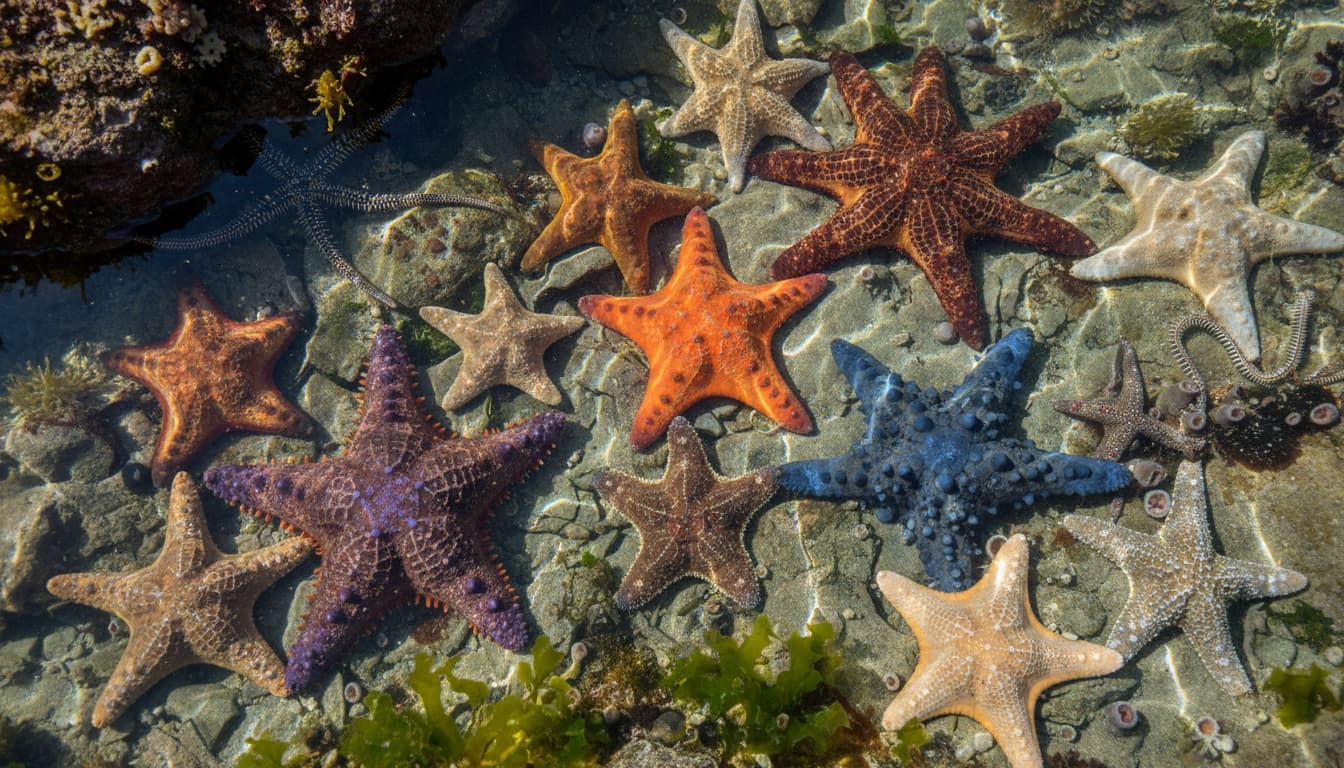
No biological difference — same animal, two names. "Starfish" is the common term; "sea star" is scientifically preferred because these animals lack gills, fins, and scales. NOAA and modern field guides use "sea star."
This guide uses "sea star" throughout, because that's what you'll see in iNaturalist records and regional ID databases. NOAA's Ocean Service puts the global species count at approximately 2,000, spread across every major ocean. They belong to class Asteroidea, phylum Echinodermata — the same phylum as sea urchins and sand dollars. No freshwater sea star species exists.
---
2. Sea Star Anatomy: The Features That Actually ID a Species
The first time I picked up what I was sure was an ochre star — purple, five arms, classic intertidal rock — I had it wrong. It was a mottled star, nearly twice the size I'd registered, with arms that tapered in a way I'd just... not noticed. That's the thing about sea star identification: one feature misleads you, and the whole ID falls apart.
The Five Key Anatomy Features
Arm count is your first filter. Five arms is the default — sea stars have five-point radial symmetry as a baseline body plan, per NOAA's Ocean Service. But that baseline breaks quickly: species with 10, 20, or even 40 arms exist. The sunflower star (Pycnopodia helianthoides) typically carries 20 or more arms. The rose star runs 8–16.
Surface texture narrows the field fast. Here's the plain-English breakdown:
- Spiny: visible raised spines or ossicles (calcium carbonate plates embedded in the body wall) — think ochre star
- Granular: fine, pebbly surface, like coarse sandpaper
- Smooth/leathery: soft, almost rubbery feel — leather star is the textbook example
- Papulae: tiny skin gills that look like soft bumps; present on many species
- Pedicellariae: microscopic pincer-like structures between spines that grab debris; not visible to the naked eye but affect texture
Color is the most overrated sea star characteristic. I've watched confident observers call a purple animal an ochre star, then watch their certainty collapse when the arm count came up wrong. A single species can run purple, orange, brown, or yellow depending on depth, age, and the individual animal. Always confirm with texture and arm count.
Size gives you a practical range filter. The blood star (Henricia leviuscula) tops out around 25 cm, per regional field data from Edmonds Underwater Park. The sunflower star reaches 1 meter across. That's a 4x size difference — useful when you're standing over a tide pool.
The madreporite (a small, pale, sieve-like plate on the aboral surface) is a key confirmatory feature for separating closely related species. Check the underside when you can, without lifting the animal. Tube feet run in grooves along each arm.
Seasonal and Tidal Variation in Sea Star Coloration
These features aren't static, though — timing and conditions shift what you actually see.
Spawning season affects coloration in some species. Ochre stars in particular can show more vivid pigmentation during spring spawning events on the Pacific Coast. Low-tide exposure bleaches color in shallow intertidal animals; always ID in water or within 60 seconds of emersion for accurate color assessment. Juveniles frequently don't match adult coloration either, which is a genuine source of misidentification in the field.
Behavioral Traits as Field ID Tools
Beyond morphology, behavior itself can get you to the right genus before you've measured anything.
Speed is itself a field mark. If a large multi-armed sea star is visibly moving while you watch it, it's almost certainly a sunflower star. NOAA reports adult sunflower stars move at up to 1 meter per minute using over 15,000 tube feet. No other Pacific species moves fast enough to notice in real time. Leather stars, by contrast, are sluggish and tend to stay wedged under rock overhangs.
Which Creature Has Eyes on Its Arms?
Sea stars do. Each arm tip carries a primitive light-sensing structure. These aren't image-forming eyes — they detect light and shadow, helping the animal orient toward or away from light.
---
3. How to Use a Sea Star Identification Key
A dichotomous key is a branching series of either/or questions. Each answer eliminates species until one remains. No special training needed — any starfish identification key runs on the same logic: two choices, eliminate half the options, repeat.
The CatchRules 5-Step Sea Star Field ID Method
Step 1 — Arm count: Five arms, or more than five? More-than-five immediately narrows you to a short list: sunflower star, rose star, crown-of-thorns, spiny sun star.
Step 2 — Size: Under 15 cm / 15–50 cm / over 50 cm. A 10 cm orange star and a 60 cm orange star are almost certainly different species.
Step 3 — Surface texture: Spiny and rough, smooth and leathery, or somewhere between? Run your eye (not your hand) along the arm surface.
Step 4 — Dominant color(s): Record what you see, but treat it as supporting evidence only — never the primary ID feature.
Step 5 — Region and habitat: Intertidal rocky reef, sandy bottom, subtidal kelp forest? Two species sharing a coastline often partition habitat by depth. Confirm your geographic region.
Run all five steps before you call it. One step alone will mislead you.
Regeneration and Arm Count Variations: Don't Let This Fool You
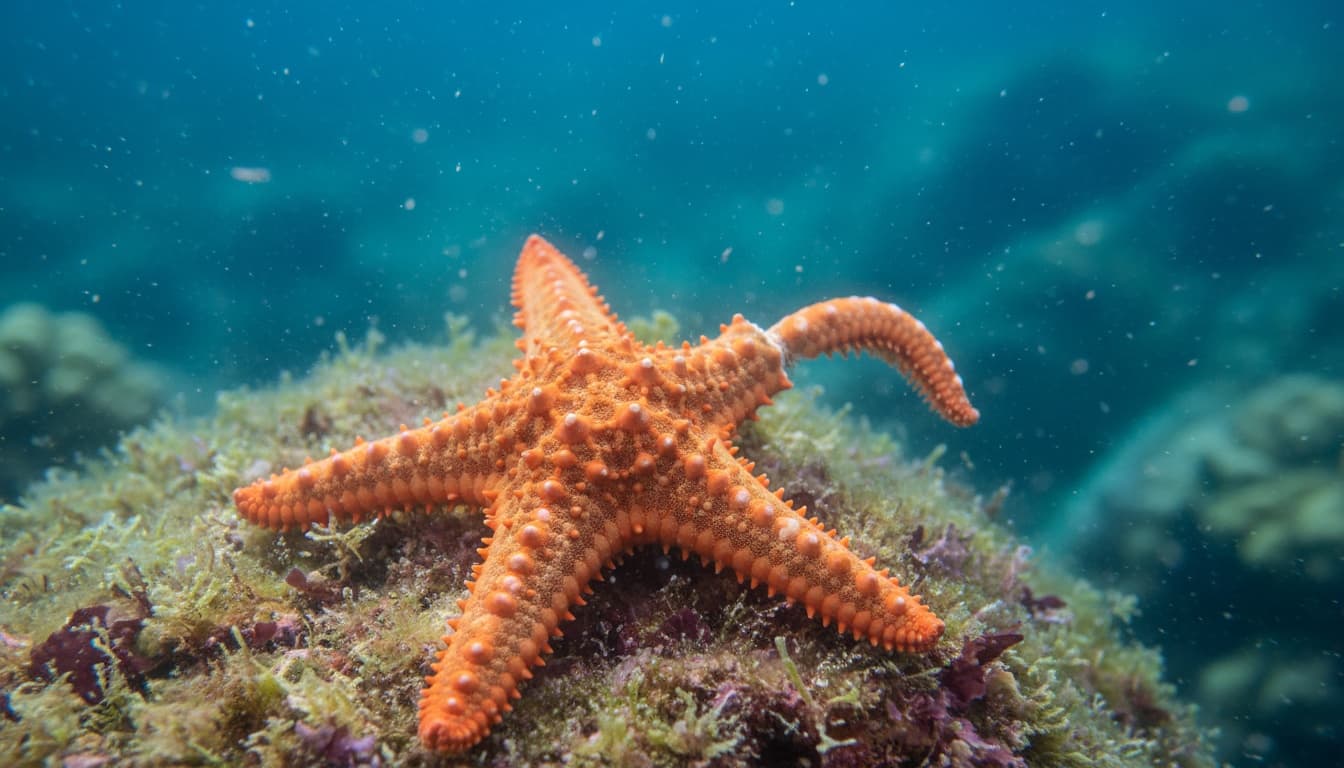
Sea stars regenerate lost arms, per NOAA. A specimen mid-regeneration shows one visibly shorter arm, or sometimes four short stubs and one long arm, called a "comet" form. Some species can regenerate an entire body from a single arm. Always check all arms before recording a count, and don't disqualify a 5-armed species because one arm looks stubby.
---
4. Common Sea Stars by Region: Species You're Most Likely to See
Pacific Coast (Including Puget Sound)
Ochre sea star (Pisaster ochraceus) The most common intertidal species on the West Coast. iNaturalist has logged over 51,000 North American observations for this species.
- Arms: 5 | Size: 15–30 cm | Texture: Spiny | Depth: Intertidal to 70 m
- Color runs purple, orange, or brown within the same population — color alone will not ID this species
Sunflower star (Pycnopodia helianthoides) Critically endangered following Sea Star Wasting Disease population collapses. Rarely seen intertidally now.
- Arms: 20+ | Size: Up to 1 m | Texture: Soft, pliable | Depth: Intertidal to 437 m (Edmonds Underwater Park records)
- If a large multi-armed star is visibly moving while you watch, it's almost certainly this species
Blood star (Henricia leviuscula) Often found subtidally on sponge-covered rock. Long, slender arms distinguish it from most Pacific species.
- Arms: 4–6 | Size: Up to 25 cm | Texture: Smooth | Depth: 0–700 m
- Range: Alaska to Baja California
Leather star (Dermasterias imbricata) I've used the garlic odor this species produces to settle arguments at the tide line. Nothing convinces a skeptic like making them smell the animal.
- Arms: 5 | Size: Up to 30 cm | Texture: Smooth, leathery | Depth: 0–100 m
- Gray-blue with red mottling; range Alaska to California
Mottled star (Evasterias troschelii) The species most likely to fool you if you're used to ochre stars. Longer, more tapered arms are the tell.
- Arms: 5 | Size: Up to 60 cm | Texture: Granular | Depth: Intertidal to 70 m
- Mottled brown/orange; arm width at the base is noticeably slimmer than ochre star relative to arm length
Rose star (Crossaster papposus) Also called "spiny sun star" in North Atlantic literature — same species, regional name variation.
- Arms: 8–16 | Size: Up to 30 cm | Texture: Spiny | Depth: To 1,300 m
- Concentric rings of red, pink, and white; unmistakable pattern
Atlantic Coast
Common sea star (Asterias rubens) The default starfish of the North Atlantic. Abundant on rocky intertidal shores.
- Arms: 5 | Size: 10–30 cm | Texture: Spiny | Color: Orange-brown
Forbes' sea star (Asterias forbesi) Range overlaps with A. rubens in the Mid-Atlantic. Color alone will not separate them.
- Arms: 5 | Size: 10–25 cm | Texture: Spiny | Color: Orange-brown
- Orange madreporite is the only reliable field mark (see Misidentifications below)
Caribbean
Cushion sea star (Oreaster reticulatus) Unmistakable in adults — thick, domed body unlike anything else in Caribbean waters.
- Arms: 5 | Size: Up to 50 cm | Texture: Thick, domed | Color: Orange/red/brown
- Reported as protected in several Caribbean jurisdictions. Always verify with your regional fisheries or wildlife agency before handling or collecting.
Comet sea star (Linckia guildingii) Commonly encountered as comet regeneration forms, which are often misidentified as a different species entirely.
- Arms: 5 | Size: 10–20 cm | Texture: Smooth | Color: Gray-green
Indo-Pacific and Indian Ocean
Blue sea star (Linckia lamarckii) Color fades within minutes out of water. Photograph immediately and in situ.
- Arms: 5 | Size: 20–30 cm | Texture: Smooth | Color: Vivid blue in life
- Found across Indo-Pacific and Indian Ocean reef systems
Crown-of-thorns (Acanthaster planci) Do not handle. Venomous spines. A reef predator with documented population outbreaks on the Great Barrier Reef.
- Arms: 10–20 | Size: Up to 80 cm | Texture: Venomous spines | Color: Red/gray/green
- Always verify current management status with the Australian Institute of Marine Science (AIMS) before reporting an observation
Chocolate chip sea star (Protoreaster nodosus) Hard to misidentify. The dark conical spines on a tan body are distinctive at any size.
- Arms: 5 | Size: 20–40 cm | Texture: Conical spines | Color: Tan with dark brown spines
---
5. Sea Star Quick-Reference Identification Chart
Use this as a first-pass field filter. Confirm with a full field guide or the CatchRules species database before recording.
| Common Name | Scientific Name | Region | Arm Count | Size Range | Key Field Mark |
|---|---|---|---|---|---|
| Ochre sea star | *Pisaster ochraceus* | Pacific (NA) | 5 | 15–30 cm | Color polymorphism; spiny surface |
| Sunflower star | *Pycnopodia helianthoides* | Pacific (NA) | 20+ | Up to 1 m | Largest NA sea star; visibly fast-moving |
| Blood star | *Henricia leviuscula* | Pacific (NA) | 4–6 | Up to 25 cm | Slender arms; sponge habitat |
| Leather star | *Dermasterias imbricata* | Pacific (NA) | 5 | Up to 30 cm | Garlic odor; smooth leathery surface |
| Mottled star | *Evasterias troschelii* | Pacific/Puget Sound | 5 | Up to 60 cm | Long tapered arms; slim arm base |
| Rose star† | *Crossaster papposus* | Pacific + N. Atlantic | 8–16 | Up to 30 cm | Concentric red/pink/white ring pattern |
| Common sea star | *Asterias rubens* | N. Atlantic | 5 | 10–30 cm | Abundant; rocky intertidal |
| Forbes' sea star | *Asterias forbesi* | W. Atlantic | 5 | 10–25 cm | Orange madreporite (only reliable mark) |
| Cushion sea star | *Oreaster reticulatus* | Caribbean | 5 | Up to 50 cm | Dome shape unmistakable |
| Comet sea star | *Linckia guildingii* | Caribbean | 5 | 10–20 cm | Common in comet regeneration form |
| Blue sea star | *Linckia lamarckii* | Indo-Pacific | 5 | 20–30 cm | Vivid blue; color fades out of water |
| Crown-of-thorns | *Acanthaster planci* | Indo-Pacific | 10–20 | Up to 80 cm | Venomous spines — do not handle |
| Chocolate chip star | *Protoreaster nodosus* | Indo-Pacific | 5 | 20–40 cm | Dark conical spine pattern |
†Rose star (Crossaster papposus) is also called "spiny sun star" in North Atlantic literature. Same species, regional common name variation.
Conservation statuses per IUCN Red List (verify current listings, as statuses are periodically updated): Sunflower star — Critically Endangered. Cushion sea star — Near Threatened. Ochre sea star and common sea star — Least Concern. All others — Not Assessed or data deficient.
Do not remove sea stars from the water for identification. Observe in place. If you briefly lift one for a look at the underside, replace it on the same rock surface, same orientation, within 30 seconds.
---
6. When the Chart Narrows It to Two: Confirming a Borderline ID
When you're standing over a tide pool with two candidates and no cell signal, CatchRules cross-references arm count, texture, and region against its full species database to surface the most likely match — offline, no signal required. Point the app at a sea star and it cross-references your field observations against its full species database to confirm the ID before you record it.
---
7. Common Misidentifications and How to Avoid Them
⚠️ Common confusion: Ochre star vs. mottled star
This is the most common misidentification I see logged on iNaturalist for Pacific Northwest observers. Both are 5-armed with overlapping colors, and in Puget Sound especially, they share the same rocky intertidal habitat. The mottled star has longer, more tapered arms and averages larger (up to 60 cm vs. 30 cm). Measure arm width at the base — mottled star arms are noticeably slimmer relative to arm length.
⚠️ Common confusion: Forbes' sea star vs. common sea star
The Atlantic coast has its own version of this problem. The color is identical. The range overlaps. The only reliable field mark is the madreporite — orange on Forbes', pale on A. rubens. That's it. One feature.
When one feature separates two species and you're not sure you're reading it right, CatchRules cross-references all five field marks simultaneously — offline, no signal needed.
⚠️ Common confusion: Rose star vs. spiny sun star
One confusion is simpler than it looks. These are the same species (Crossaster papposus). "Rose star" and "spiny sun star" are regional common names for one animal. Don't treat them as separate species.
⚠️ Common confusion: Juvenile cushion stars
Juveniles are flatter and less domed than adults. Often called a different species entirely by new observers. Size and the characteristic domed profile develop with age.
⚠️ Common confusion: Comet forms
A regenerating sea star with one long arm and four tiny stubs is not a new species. It's a recovering individual. Arm count on a comet form is meaningless for ID.
Most sea star misidentification happens because people over-trust color and under-use size. Color varies enormously within a single species. A 10 cm measurement takes three seconds and eliminates half your candidate species list. Measure first, color second.
What Eats Sea Stars?
Knowing what preys on sea stars helps you interpret damaged specimens in the field.
Sea otters and wolf eels are the primary predators. Gulls take them in the intertidal zone. Other sea stars will eat them too. A damaged specimen with missing arms is still identifiable by texture, color pattern, and remaining arm morphology — don't discard a partial specimen from your observation log.
What Do Sea Stars Eat?
Sea stars are just as often the predator as the prey.
Most are opportunistic predators. Bivalves — mussels, clams, oysters — are primary prey for many common species. Crown-of-thorns targets coral polyps directly, and sea urchins are on the menu for several Pacific species. Ecologist Robert Paine's 1966 research on Pisaster ochraceus established sea stars as keystone predators in Pacific intertidal communities. It remains the foundational reference on ochre star predation ecology (Paine, R.T., The American Naturalist, 1966).
---
8. Frequently Asked Questions
How do I identify a sea star by species in the field? Count arms first, then measure approximate diameter, then note surface texture. Record color last — it's supporting evidence, not primary ID. Cross-reference with a regional species list. The CatchRules 5-Step Field ID Method walks through this sequence in under two minutes.
How many arms does a sea star have? Most have 5, but sea star species range from 4 to 40, per NOAA's Ocean Service. The sunflower star typically has 20 or more. The rose star runs 8–16. Always count all arms — but check for regeneration stubs before recording your count.
Why do sea stars of the same species look different colors? Color varies with depth, age, individual genetics, and lighting conditions. Ochre stars range from purple to orange to brown within the same population. Never identify a sea star by color alone. Texture and arm count are more reliable.
Are sea stars dangerous to touch? Most species are harmless to handle briefly. Crown-of-thorns (Acanthaster planci) carries venomous spines — do not touch. Beyond venom, handling stresses the animal and can damage its tube feet. Observe without touching whenever possible.
What is the difference between a sea star and a sea urchin? Both are echinoderms, but sea urchins have a rigid spherical shell (test) covered in movable spines, while sea stars have a flexible body with distinct arms. They are related but belong to different classes within phylum Echinodermata.
What happened to the sunflower star? Sea Star Wasting Disease (SSWD), which devastated Pacific populations starting in 2013, has left sunflower star numbers critically low. The species is listed as Critically Endangered by the IUCN. Recovery efforts are ongoing — check NOAA Fisheries for current status and confirmed sighting ranges before reporting an observation.
---
9. Key Takeaways
- "Sea star" and "starfish" mean the same animal; sea star is the scientifically preferred term
- NOAA's Ocean Service puts the global count at approximately 2,000 species; all live exclusively in saltwater
- Count arms first, measure size second, note texture third — use color last
- The sunflower star (up to 1 m, 20+ arms, 15,000+ tube feet) is the largest North American species and is now Critically Endangered
- Regenerating "comet" forms can confuse arm counts — always check all arms
- Never ID by color alone; ochre stars range from purple to orange to brown within the same population
- Do not remove sea stars from the water; observe in place