
1. How to Tell Striped Bass from White Bass in Under 30 Seconds
We've watched experienced anglers — people who fish 80 days a year — hold up a white bass and call it a striper. The stripes looked right. The fish was silver. They were wrong. Here's how to not be that person.
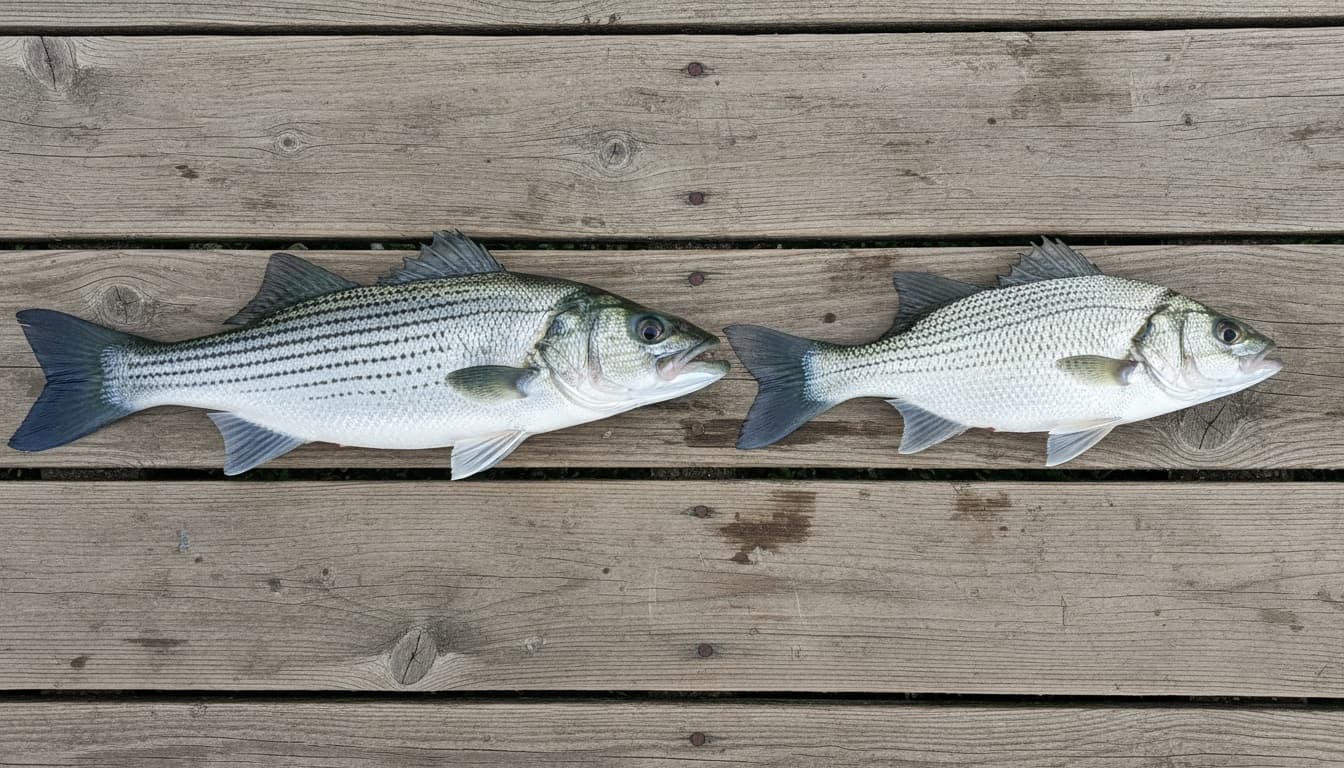
Check three things: size (striped bass 5–30 lbs, white bass 1–3 lbs), stripe continuity (striped bass unbroken, white bass broken below lateral line), and mouth (striped bass two tongue patches, white bass one). The mouth test is definitive. You can settle the question in under 30 seconds.
Both species belong to Moronidae, the temperate bass family. Both are silver-white with horizontal markings. That shared profile is exactly why misidentification happens so often, even among experienced anglers.
The third variable that complicates things: hybrid striped bass, called wipers. A wiper is a hatchery cross between the two species, and it sits visually between them.
Oklahoma's Byron State Fish Hatchery produces wipers by fertilizing female striped bass eggs with male white bass milt — a technique refined since the first Oklahoma stocking at Sooner Lake in 1977, according to the Oklahoma Department of Wildlife Conservation. Wipers look like a compromise: some broken stripes, a slightly arched back, intermediate size. See the hybrid striped bass wiper identification guide for photo comparisons across size classes. Relying on stripes alone won't sort a wiper from either parent.
The mouth test will.
---
2. Physical Differences: Stripes, Body Shape, and Size
Stripe pattern is the first thing most anglers check — and it's useful, just not foolproof.
Striped bass carry 7–8 dark, continuous horizontal stripes running from the gill plate to the tail. Per the ODWC, the lines are usually unbroken, even in juveniles above about 6 inches. White bass have fewer stripes, and the ones below the lateral line are almost always broken, faded, or absent entirely.
Body shape is a useful secondary check. Striped bass are elongated and torpedo-shaped — built for open water and long migrations. White bass are deeper-bodied and more laterally compressed. That shape difference matters when you're holding a 3 lb fish and trying to decide.
Both species have two dorsal fins. Spine prominence varies too much between individual fish to use as a reliable identifier.
Size and Weight Comparison
| Measurement | Striped Bass | White Bass | Hybrid (Wiper) |
|---|---|---|---|
| Typical catch weight | 5–30 lbs | 1–3 lbs | 2–8 lbs |
| World record | 81.88 lbs (Connecticut, 2011) | ~7 lbs | ~27 lbs |
| Average length | 18–36 inches | 10–15 inches | 14–20 inches |
| Back profile | Flat | Slightly arched | Noticeably arched |
| Stripe pattern | Unbroken, 7–8 lines | Broken below lateral line | Mixed, some broken |
What Two Fish Make a Striped Bass?
Striped bass (Morone saxatilis) is a pure species — it's not a hybrid of anything. It breeds true. The confusion comes from wipers, which ARE a two-species cross: female striped bass × male white bass milt. If someone asks what two fish make a striped bass, the honest answer is: none. It's its own fish. The hybrid question is a different question entirely.
Is White Bass the Same as a Striper?
No. White bass (Morone chrysops) and striped bass (Morone saxatilis) are distinct species within the same family. White bass are smaller, purely freshwater fish that rarely exceed 5 lbs. Striped bass are larger, anadromous fish that migrate between saltwater and freshwater to spawn. "Striper" refers specifically to striped bass — it's not a generic term for the family.
---
3. The Mouth Test: 100% Accurate Identification Method
Here's the contrarian take most fishing guides skip: stripe patterns are unreliable enough that you should treat the mouth test as your first check, not your last.
Juvenile striped bass can have broken stripes. Large white bass can have surprisingly clean markings. Wipers sit in the middle of both. Visual ID from the body alone fails regularly in borderline cases.
The mouth test doesn't fail.
How to do it:
- Hold the fish firmly. Wet gloves help — the fish is slippery and the teeth are sharp.
- Open the mouth and look at the tongue.
- Press gently on the tongue surface with a gloved finger to feel for tooth patches.
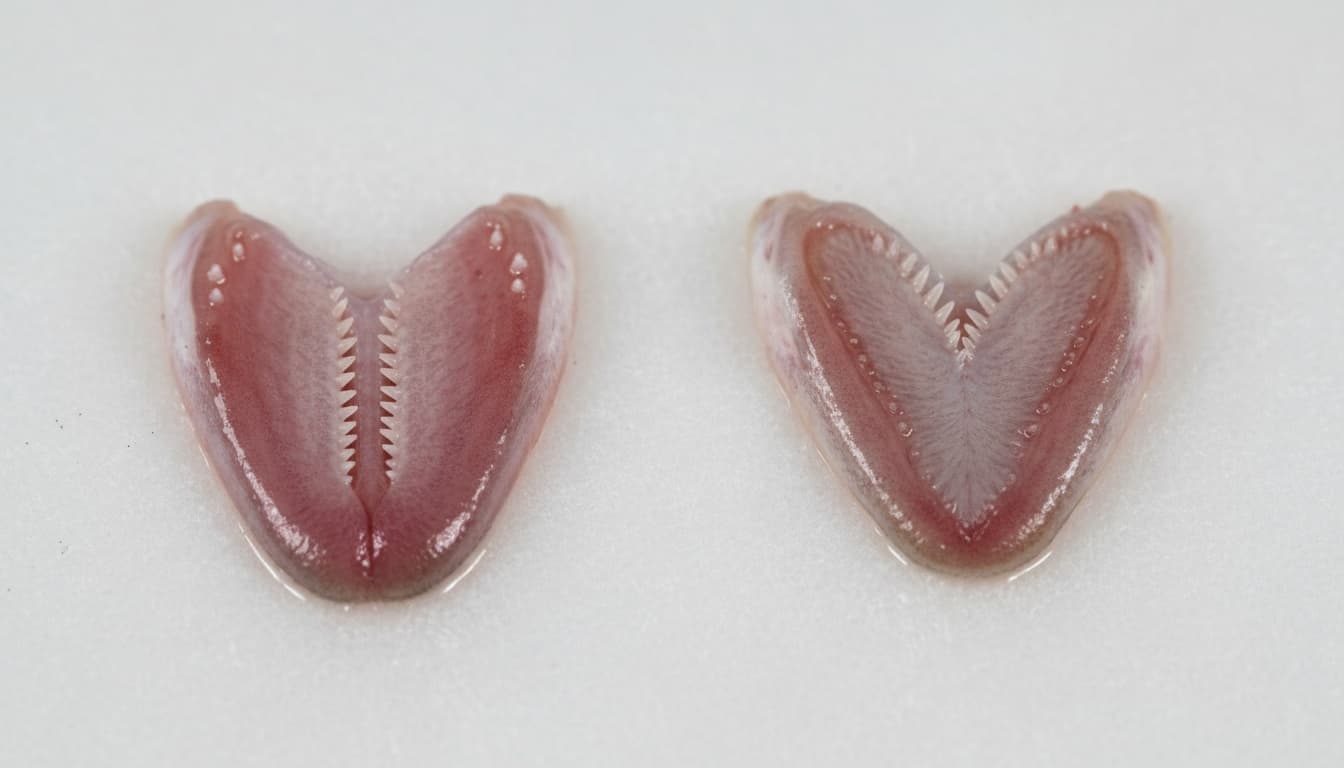
Striped bass have two distinct tooth patches on the tongue — one near the tip, one toward the back. White bass have one tooth patch, centered on the tongue. This difference is confirmed by the Oklahoma Department of Wildlife Conservation and holds true across the species' entire range. Hybrid striped bass also have two tongue patches, per the ODWC, which means the mouth test distinguishes white bass from both striped bass and wipers, but won't separate a wiper from a pure striper on its own.
The test works on live fish, fish just pulled from the water, or fish that have been on ice for a few hours. No scale, no ruler, no field guide required.
We've watched an angler at Lake Texoma spend 20 minutes arguing that a 4 lb fish was a striped bass because the stripes looked clean. Opened the mouth: one tooth patch. White bass. The tongue test ended the argument in 10 seconds.
The mouth test works on any size fish and requires no tools — but if you're fishing unfamiliar waters, having a species identification guide you can reference offline eliminates second-guessing at the cleaning table.
---
4. Where Do Striped Bass and White Bass Live?
Striped bass are anadromous — born in rivers, they grow in the ocean and return to spawn. White bass are strictly freshwater. Both are found in large southern reservoirs and river systems, often in the same water during spring spawning runs, which is exactly when ID questions matter most.
Here's the life cycle that makes striped bass different from almost every other fish you'll target in freshwater: they're born in rivers, grow up in the ocean, and come back to spawn. That's anadromous. White bass never do any of that — they're born in freshwater, live in freshwater, die in freshwater.
Full stop. They never leave.
Striped bass (Morone saxatilis — more on striped bass) have a native range along the Atlantic coast. They've been introduced on the Pacific coast and into dozens of inland reservoirs. The landlocked populations are worth knowing about.
Native Range and Stocking History
Dam construction on the Santee-Cooper River in South Carolina during the 1940s accidentally trapped a striped bass population, according to the ODWC. Those fish adapted, proved they could reproduce in freshwater, and became the genetic stock for stocking programs across the country. Lake Texoma, on the Oklahoma-Texas border, now supports one of the most prolific naturally reproducing landlocked striped bass populations in the U.S. Naturally reproducing populations have also established in Lake Keystone and the Arkansas River Navigation System.
White bass (Morone chrysops — white bass species profile) are strictly freshwater. They've been widely stocked across the central and southern U.S. but never migrate to saltwater.
Stocking programs are active across both species' ranges. Oklahoma's wiper stocking program continues to expand into smaller impoundments — check the ODWC's current stocking report for updated water-by-water data before your trip. For current population data and stocking reports, the ODWC's striped bass angler guide is updated annually.
The geographic overlap zones where anglers most commonly confuse the two: large southern reservoirs during spring, and river mouths during spawning runs. Striped bass spawn when water temperatures hit 55–70°F, peaking around 65°F, per the ODWC. White bass spawn in early spring too, pushing up tributary streams in March and April. Both species show up in the same water at the same time of year.
Is Striper the Same as Bass?
"Striper" means striped bass specifically. Striped bass belong to Moronidae (temperate basses). Largemouth, smallmouth, and spotted bass belong to Centrarchidae — a completely different family. They share the word "bass" but are not closely related. "Sea bass" is something else entirely: black sea bass (Centropristis striata) belongs to Serranidae. Different family, different regulations.
Both striped bass and white bass are subject to size and bag limits that vary by state. Always verify current rules with your state fish and wildlife agency before keeping fish.
---
5. Fishing Tips: Bait, Tackle, and Seasonal Techniques
Striped bass: Live bait — bunker (menhaden), eels, herring — is the gold standard on the Atlantic coast. Inland, large swimbaits from 3–8 inches (per ODWC tackle recommendations), bucktail jigs, and topwater plugs during fall blitzes all produce. Target structure, current seams, river mouths, and open-water schools marked on sonar.
White bass: Light to medium spinning gear, lighter line. Small jigs (1/8–1/4 oz), curly-tail grubs (2–6 inches, per ODWC), small spinners, and live minnows. The best fishing happens during spring spawning runs in tributary streams. In summer, find them on main lake points chasing shad schools.
Hybrid striped bass (wipers): Lipless crankbaits in 2–4 inches, lipped crankbaits 3–5 inches, jerkbaits 3–6 inches, and slabs or blade baits in 1/4–1 oz all work, per ODWC tackle data. Wipers school in open water and crash shad on the surface. Watch for birds.
One common mistake we've seen repeatedly: anglers fishing shared reservoirs bring white bass tackle and hook a striped bass. The result is a break-off, a lost fish, and sometimes a damaged fish that's released in poor condition. If the water holds stripers, rig accordingly.
How Each Species Feeds
Understanding how each species feeds changes where you cast. Striped bass are ambush predators — they hold in current seams, behind structure, and at depth, waiting for baitfish to come to them. White bass hunt differently: they're pack animals that push shad schools to the surface and crash them from below. That's why you'll see white bass blitzes on open water with birds working overhead. Wipers do both, which makes them unpredictable in a good way.
Feeding behavior also shifts seasonally. In summer, both species follow baitfish — primarily menhaden and shad — into open water. In fall, striped bass blitzes are some of the most visible feeding events in freshwater fishing: fish crashing the surface, birds diving, bait spraying. White bass do the same thing on a smaller scale.
Angler's Quick-Reference Comparison
| Variable | Striped Bass | White Bass | Wiper |
|---|---|---|---|
| Best bait | Live bunker, large swimbaits | Small jigs, live minnows | Mid-sized jigs, crankbaits |
| Best season | Spring (spawning), fall (blitzes) | Early spring (spawning runs) | Spring–summer |
| Open-water schooling | Yes | Yes | Yes |
| Difficulty to catch | Moderate–high | Low–moderate | Moderate |
---
6. Which One Tastes Better — and How to Prepare It
Ask any charter captain on the Chesapeake what they'd rather eat for dinner — striped bass wins every time. The flesh is firm, mild, and sweet with almost no "fishy" flavor from clean waters. Wild fish from coastal environments tend to have higher omega-3 content, reflecting the richer saltwater diet.
Flavor and Nutrition Comparison
Nutritionally, the gap is smaller than the flavor gap. A 3 oz serving of wild striped bass runs approximately 105 calories, 19g of protein, and 2.3g of fat (per USDA nutritional database). White bass comes in at roughly 98 calories and 17g of protein per 3 oz. Both are lean, high-protein fish. The difference is in the eating experience, not the macros.
White bass is edible, but it requires more care. The red lateral line meat running through the fillet is the source of most of the strong flavor. Remove it. Bleed the fish immediately after catch and get it on ice. Skip either step and white bass can taste genuinely unpleasant. That's not a knock on the species; it's just how the fish is built.
Hybrid striped bass sits between the two on flavor: firmer than white bass, milder than a strong wild striper.
How to Clean White Bass vs Striped Bass
White bass requires one extra step that most anglers skip: remove the red lateral line meat. After filleting, you'll see a dark red strip running lengthwise through the fillet. Slide your knife just under it and peel it away. That strip is where the strong flavor lives. Skip this and the fish tastes like river mud. Do it and you have a clean, mild fillet worth eating.
Unlike white bass, striped bass doesn't have this problem. Fillet normally, skin optional. The flesh is firm enough to hold up on a grill without falling apart — something white bass fillets won't do. For both species: bleed the fish immediately at catch, pack in ice, and process within 24 hours. White bass is good fried or smoked if handled correctly. Striped bass takes well to grilling, baking, or pan-searing.
Price and Market Value
If you're buying rather than catching: wild striped bass typically runs $18–28/lb at retail in most coastal markets — check current prices locally as they vary by season and region. White bass isn't commercially sold in most states — it's a sport fish. Farmed hybrid striped bass (labeled "striped bass" at many restaurants) runs $12–18/lb wholesale and is what you're usually eating when a menu says "striped bass" without specifying wild-caught.
Is Striped Bass a Good Eating Fish?
Yes. Striped bass is restaurant-quality table fare. Firm, mild, sweet flesh. Grill it or pan-sear it with butter and herbs. Wild fish from clean coastal waters is the best version. Check local health advisories before eating striped bass from certain coastal areas — PCBs are a documented concern in some Northeast waters. White bass is good fried or smoked if handled correctly post-catch.
---
7. 5 Misidentification Mistakes That Cost Anglers Violations (and How to Avoid Them)
The CatchRules 4-Step Species Confirmation Ladder
We built this decision sequence after observing repeated misidentification patterns at Lake Texoma and reviewing ODWC field identification protocols.
Step 1 — Check size. A fish over 10 lbs is almost certainly a striped bass or wiper. Under 3 lbs, probably a white bass. But size alone doesn't close the case.
Step 2 — Check stripe continuity. Continuous, unbroken stripes from gill to tail point to striped bass. Broken stripes below the lateral line suggest white bass or wiper. Still not definitive.
Step 3 — Open the mouth and check tongue patches. Two patches: striped bass or wiper. One patch: white bass. This step eliminates white bass from the equation.
Step 4 — Confirm regulations before keeping. Species confirmed, now check your state agency's current rules. Bag limits and size minimums differ by species and by water body. Always verify with your state fish and wildlife agency before keeping or releasing.
---
Mistake #1: Relying on stripe count alone. Juvenile striped bass have variable stripe patterns. Always use the tongue test.
Mistake #2: Confusing wipers with either parent. The arched back and intermediate stripes are clues, but the tongue test separates white bass from both striped bass and wipers.
Mistake #3: Calling any silver bass-shaped fish a "striper." Yellow bass (Morone mississippiensis) is a third related species found in the Mississippi basin. Three things separate it from white bass and striped bass: (1) stripes below the lateral line are offset — they don't align with the ones above; (2) it rarely exceeds 1 lb; (3) it shows up across the central U.S. in the same water as white bass. Once you know to look for that offset, yellow bass are easy to separate.
Mistake #4: Assuming size determines species. A 3 lb white bass and a 3 lb juvenile striped bass look surprisingly similar. Check the mouth.
Mistake #5: Ignoring regulations because of misidentification. Keeping a striped bass under a white bass ID — or the reverse — can result in a violation. When in doubt, use the tongue test. If you're still uncertain, release the fish. Always verify with your state fish and wildlife agency before keeping any fish.
---
8. FAQs
Q: What is the easiest way to tell a striped bass from a white bass? Open the mouth and check the tongue. Striped bass have two distinct tooth patches — one near the tip, one toward the back. White bass have one centered patch. Per the Oklahoma Department of Wildlife Conservation, this test works on any size fish and is more reliable than stripe patterns or body shape alone. No tools required.
Q: Can white bass and striped bass live in the same lake? Yes. Large southern reservoirs — especially in Oklahoma, Texas, and the Carolinas — are stocked with both species and often wipers too. Spring spawning runs bring all three into the same water at the same time, which is exactly when identification questions matter most for anglers trying to stay within legal limits.
Q: How big do white bass get compared to striped bass? White bass rarely exceed 5 lbs. Striped bass routinely reach 20–40 lbs in good habitat, and the world record stands at 81.88 lbs — a fish caught off Westbrook, Connecticut in 2011. There's no meaningful size overlap once both species are mature.
Q: Are hybrid striped bass (wipers) safe to eat? Yes. Wiper flesh is firm and mild — most anglers rate it above white bass and close to striped bass in quality. Clean and ice them promptly after catch, same as any fish, and process within 24 hours for best flavor and texture. The lateral line removal step that white bass requires is not necessary with wipers.
Q: Do striped bass and white bass taste different? Significantly. Striped bass flesh is firm, mild, and sweet — ask any charter captain on the Chesapeake. White bass has a stronger, more pronounced flavor and softer texture. It benefits from removing the red lateral line meat immediately after filleting and getting the fish on ice within minutes of catch for best results.
Q: What is a "sunshine bass"? Sunshine bass is another name for hybrid striped bass, also called a wiper. The term is used interchangeably in some states. It refers to the same hatchery cross: female striped bass eggs fertilized with male white bass milt. Sunshine bass behave and taste like wipers in every respect — same ID methods apply.
Q: What's the best way to confirm species ID in the field without a printed field guide? The tongue test requires no tools and works on any size fish. For visual confirmation — especially with wipers — CatchRules provides offline species profiles with photo comparisons so you can check your catch at the dock without cell signal. It also surfaces current state regulations so you know what you're legally holding.
---
9. How CatchRules Helps
CatchRules classifies over 1,000 species — including the striped bass identification guide and white bass species profile — with side-by-side photo comparisons available offline. That means you can confirm your catch's identity at the dock without cell signal, and check current size and bag limits from your state agency before you leave the water — not after you've already made a mistake.
---