
1. What Are Barnacle Types? Definition and Classification
Here's the misconception that trips up almost everyone: barnacles are crustaceans, not mollusks. They belong to phylum Arthropoda, subclass Cirripedia (elevated to subclass by Chan et al. in 2021, per Wikipedia's barnacle taxonomy entry), which puts them firmly in the same lineage as crabs and shrimp.
The classification runs: phylum Arthropoda → subclass Cirripedia → orders (Thoracica, Rhizocephala, Acrothoracica) → families → genera → species. Most intertidal barnacles you'll encounter belong to order Thoracica.
All barnacle types share three defining traits:
- Sessile as adults — permanently cemented to a substrate, no locomotion
- Filter feeders — six pairs of feathery thoracic limbs called cirri sweep plankton from the water column
- Oxygen absorbed through cirri and body surface, not gills
Barnacle Life Cycle: From Nauplius to Adult
That shared physiology is interesting — but the life cycle is where barnacles really reveal their crustacean ancestry. Larvae hatch as nauplii, passing through six moults across five instars before transforming into the cypris larva stage. The cypris larva is non-feeding and free-swimming, lasting anywhere from days to weeks before settling, cementing itself to a surface, and metamorphosing into an adult. That nauplius larva is the giveaway: it's the same larval form shared by all crustaceans.
Per Wikipedia, roughly 25% of barnacle species live in the intertidal zone; the remainder are subtidal, with most found shallower than 100 m. Some have been recorded at 600 m depth (around 2,000 ft).
---
2. What Are the Two Types of Barnacles? Acorn vs. Gooseneck
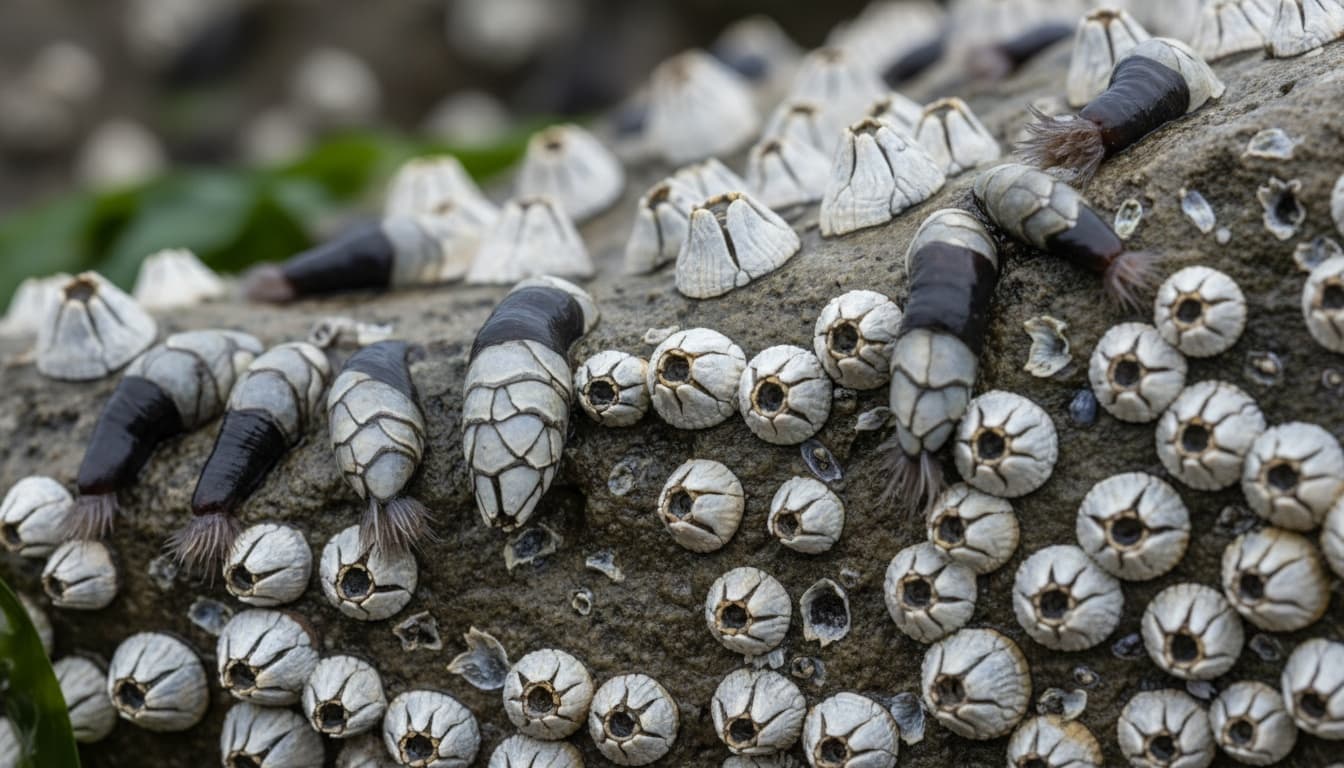
The two types of barnacles are acorn barnacles (order Thoracica, sessile, no stalk) and gooseneck barnacles (also Thoracica, but with a flexible muscular peduncle suspending the shell). That stalk, or the absence of one, determines where a barnacle can live, how efficiently it feeds, and whether you'll find it on a wave-battered headland or the bottom of a container ship.
Acorn Barnacles
Acorn barnacles attach the capitulum (the shell-bearing body) directly to the substrate with no intermediary stalk. The shell consists of six calcite wall plates surrounding the body, with an operculum of four additional plates at the top that open during feeding and close when the animal is exposed or threatened.
The cone or volcano shape is iconic. Species like the white acorn barnacle *Balanus glandula* sit squat and white on mid-intertidal rocks. Semibalanus cariosus (the thatched barnacle) has a distinctly ribbed, almost corrugated shell texture that makes it identifiable at a glance.
Most acorn barnacles tolerate desiccation well. High-zone specialists like Chthamalus dalli can survive hours of air exposure during low tide — a trait that lets them colonize the splash zone where competitors can't survive.
Gooseneck Barnacles
Gooseneck barnacles suspend their capitulum from a flexible, muscular peduncle. That peduncle can stretch and compress, letting the barnacle orient toward current flow for more efficient filter feeding. Acorn barnacles, cemented flat against rock, simply can't do that.
The pelagic gooseneck barnacle *Lepas anatifera* colonizes floating debris — logs, buoys, boat hulls — creating open-ocean rafting communities that transport organisms across ocean basins.
Pollicipes polymerus, the Pacific goose barnacle (also called the leaf barnacle), clusters on wave-exposed headlands in dense aggregations. It's the species with commercial seafood value on the Pacific coast — the same ecological niche as Pollicipes pollicipes (percebes) in Spain and Portugal, where they're considered a delicacy commanding prices exceeding €100/kg at market (as of 2025–2026 market reports).
Commercial Gooseneck Species
Here's the stranger economic puzzle: barnacle aquaculture is essentially nonexistent despite real market demand. Wild harvest of percebes in Galicia involves climbers rappelling onto wave-swept rocks at low tide — genuinely dangerous work. No one has cracked reliable aquaculture for any stalked barnacle species at commercial scale. That price gap between wild-harvested percebes and zero commercial aquaculture production is one of the stranger puzzles in seafood.
---
3. What Is the Most Common Type of Barnacle? Regional Species by Coast
Balanus glandula is the most common barnacle on the Pacific coast, dominating mid-intertidal rocky shores from Alaska to Baja California. On the cold Atlantic, Semibalanus balanoides fills the same ecological role. These two species rarely overlap except where introduced. Geography is your first filter — knowing your coast eliminates roughly half the candidate list before you examine a single shell.
Pacific Coast Barnacle Types (Pacific Northwest to Baja)
Balanus glandula anchors the mid-intertidal zone. White shell, smooth plates, roughly circular base. It's the reference species — everything else gets compared to it.
Chthamalus dalli occupies the highest intertidal splash zone, where B. glandula can't persist. Smaller (under 1 cm), gray-brown, tolerant of extreme desiccation. Where you see a band of tiny gray barnacles above the main white barnacle zone, that's Chthamalus dalli.
Semibalanus cariosus, the thatched barnacle, sits in the mid-intertidal alongside B. glandula but is immediately distinguishable by its ribbed, almost layered shell texture. Larger than B. glandula, often reaching 3–4 cm, with a corrugated surface that looks almost architectural compared to the smooth white cone next to it.
Balanus nubilus, the giant acorn barnacle *Balanus nubilus*, is the largest acorn barnacle in North America — up to 7 cm across, subtidal, found on pilings and rocky subtidal walls rather than intertidal rocks. Rarely seen without snorkeling or SCUBA.
Pollicipes polymerus (the Pacific leaf barnacle *Pollicipes polymerus*) clusters on wave-battered headlands in dense aggregations. Look for them in surge channels and exposed points, never in sheltered coves.
Vertical Zonation: Reading a Pacific Rock Face
At Shi Shi Beach or Tongue Point on the Olympic Peninsula, you can see all three Pacific acorn barnacle zones — Chthamalus above, Balanus glandula in the middle, Semibalanus cariosus below — in a single glance up the rock face. That vertical zonation is one of the most-studied examples of competitive exclusion in ecology.
Atlantic Coast Barnacle Types
Semibalanus balanoides dominates cold-water Atlantic shores from Labrador to the mid-Atlantic states. Smooth white shell, mid-intertidal, ecologically equivalent to B. glandula on the Pacific side. The two species rarely overlap.
Chthamalus fragilis fills the high-zone splash role on warm-water Atlantic shores (Virginia south to Florida), mirroring what C. dalli does on the Pacific. Smaller and less abundant than Semibalanus balanoides.
Megabalanus tintinnabulum stands out immediately — large, with pink to reddish shell coloration and a distinctly ribbed texture. Warm Atlantic waters, frequently found on boat hulls. The Megabalanus genus can reach 7 cm in length, per Wikipedia's taxonomy data.
Chesapeake Bay and Estuarine Barnacle Types
Balanus improvisus is the Chesapeake Bay barnacle — a low-salinity specialist that thrives in estuarine conditions where most marine barnacles fail. It's a major biofouling organism on boat hulls, dock pilings, and aquaculture gear throughout the Bay system. Always verify local collection and disturbance regulations with the Maryland Department of Natural Resources or Virginia Marine Resources Commission before handling or removing barnacles from any surface.
⚠️ Invasive Alert: What's Reshaping Native Distributions
Amphibalanus amphitrite (the striped barnacle) spreads via ship hulls into warm estuarine and coastal systems worldwide. If you're in the southeastern Atlantic or Gulf Coast, what looks like a native barnacle may not be. Beyond warm estuaries, Megabalanus coccopoma, native to the Pacific coast of South America, has established populations on the Atlantic coast of the southeastern United States, where it outcompetes native species for prime substrate in tide pool and low-intertidal communities. Invasive barnacle species disrupt intertidal community structure by monopolizing attachment points that native species depend on.
---
4. Barnacle Types at a Glance: Comparison Table
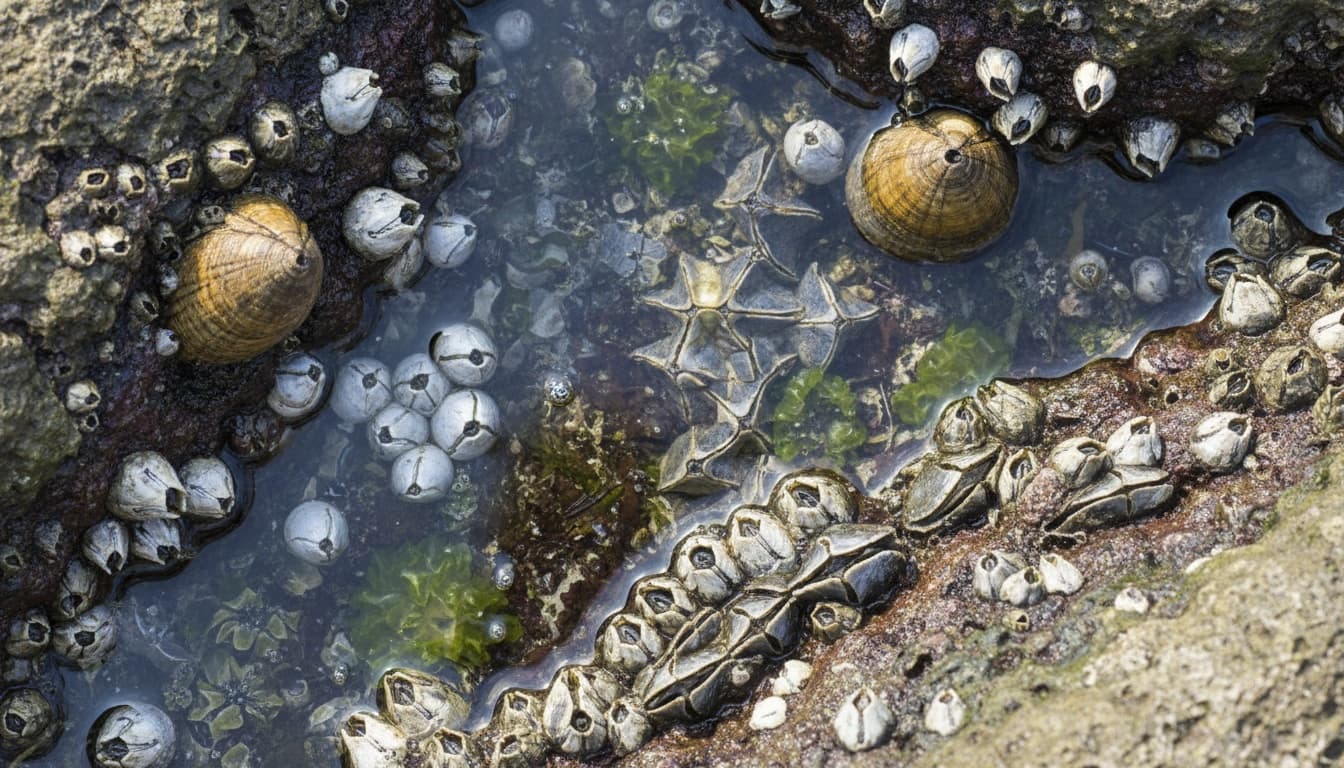
Pull out this table at the tide pool. Check shell texture first, then zone, then size — that three-step sequence eliminates most confusion species before you even look at geography.
| Common Name | Scientific Name | Size Range | Habitat Zone | Distinguishing Feature | Edible? |
|---|---|---|---|---|---|
| Acorn barnacle | *Balanus glandula* | 1–2 cm | Mid-intertidal | Most abundant Pacific species; clean white cone | Rarely |
| Chthamalus barnacle | *Chthamalus dalli* | < 1 cm | High splash zone | Tiny; highest zone of any Pacific barnacle | No |
| Thatched barnacle | *Semibalanus cariosus* | 3–4 cm | Mid-intertidal | Distinctive thatched/ribbed shell texture | No |
| Giant barnacle | *Balanus nubilus* | Up to 7 cm | Subtidal | Largest N. American acorn barnacle | Rarely |
| Common Atlantic barnacle | *Semibalanus balanoides* | 1–2 cm | Mid-intertidal | Dominant Atlantic species; no rostral pores | No |
| Estuarine barnacle | *Balanus improvisus* | 1–1.5 cm | Low intertidal/subtidal | Low-salinity tolerance; major fouling species | No |
| Goose barnacle | *Lepas anatifera* | 5–8 cm total | Floating debris, open ocean | Stalked; colonizes floating objects | Yes |
| Leaf barnacle | *Pollicipes polymerus* | 3–8 cm total | Wave-exposed rocky headlands | Stalked; dense clusters on exposed rock | Yes |
| Volcano barnacle | *Megabalanus tintinnabulum* | Up to 7 cm | Subtidal/boat hulls | Bright pink/red coloration; large size | Rarely |
| Fragile barnacle | *Chthamalus fragilis* | < 1 cm | High splash zone | Southern Atlantic equivalent of *C. dalli* | No |
Field Tip: The fastest way to narrow down barnacle type: check shell texture (smooth vs. ribbed/thatched), count the wall plates (6 = most acorn barnacles), and note the tidal height where you found it.
---
5. How to Identify Barnacle Types in the Field
Identify barnacles in four steps: check attachment style (stalk or no stalk), examine shell texture and plate count, note tidal zone and substrate, then verify size and geographic location. Each step cuts your candidate list roughly in half. No lab equipment needed.
📋 See the full species comparison table above for size ranges, shell textures, and habitat zones for all 10 species covered in this guide.
The CatchRules Barnacle Zone-to-Species Ladder gives you a repeatable sequence for narrowing any barnacle from "that crusty thing on the rock" to a confirmed species ID. Run through the steps in order.
1. Stalk or no stalk? Stalk present? Gooseneck barnacle. No stalk, shell fused directly to rock, wood, or shell? Acorn barnacle. This single observation eliminates roughly half the species list before you examine anything else.
2. Shell texture and plate count. Six wall plates is standard for acorn barnacles — that's the baseline. Texture is where you actually differentiate species: smooth white for most Balanus and Semibalanus, heavily ribbed and almost corrugated for Semibalanus cariosus, and a distinctive pink-to-red ribbed shell for Megabalanus tintinnabulum that looks almost painted. I've stood in front of Balanus glandula and Semibalanus cariosus side by side more times than I can count. The ribbed texture of cariosus is the fastest visual cue — you don't need to measure or count plates. Color also shifts with age, so compare multiple individuals when you can.
3. Tidal zone and substrate. Chthamalus spp. occupy the splash zone above the main barnacle band. Balanus glandula and Semibalanus balanoides dominate mid-intertidal. Balanus nubilus sits subtidal, rarely exposed at low tide. Substrate matters too: floating debris almost always means Lepas anatifera; exposed rocky headlands mean Pollicipes polymerus.
4. Size and geography. Size ranges differ enough to matter. Chthamalus dalli stays under 1 cm; Balanus nubilus reaches 7 cm. Pacific and Atlantic barnacle faunas overlap very little except where species have been introduced — knowing your coast eliminates most remaining confusion. iNaturalist's Cirripedia observation data for North America is a solid confirmation resource when you're back in cell range.
When you're in a tide pool without signal, CatchRules' offline species lookup works where internet-dependent tools fail — photo comparisons and species data without needing a connection.
Some species tolerate desiccation far better than others. High-zone specialists like Chthamalus dalli can endure hours of air exposure; subtidal species like B. nubilus die quickly if left exposed. That desiccation tolerance is a useful behavioral signal when tide pool zone placement alone doesn't resolve the ID. Always verify local regulations with your state's coastal management agency before collecting or disturbing any intertidal organisms.
---
6. Ecological Roles, Rare Types, and Commercial Significance
Intertidal Habitat Creation
Acorn barnacles are foundational intertidal zone species. Dense Balanus glandula colonies create microhabitat — their shells shelter amphipods, worms, and juvenile limpets that couldn't otherwise survive on bare rock. Remove the barnacles, and the associated community collapses. It's that simple.
Open-Ocean Rafting Communities
While acorn barnacles create shelter on fixed substrates, gooseneck barnacles solve a different problem entirely. A single drifting log crusted with Lepas anatifera carries dozens of associated invertebrate species — a dispersal mechanism that predates human shipping by millions of years, moving organisms across entire ocean basins long before container ships existed.
Whale barnacles deserve a specific mention here. Coronula diadema — a distinct genus, not the species you find on rocks — is commensal on humpback whales, attaching to skin without harming the host. Heavy barnacle infestations on sea turtles, by contrast, can indicate the animal is compromised. The relationship varies by host species.
Biofouling Economics
Biofouling is the economic side of this ecology. Balanus improvisus and Amphibalanus amphitrite on ship hulls increase drag and fuel consumption — a 2023 study cited by the International Maritime Organization estimated barnacle fouling increases fuel consumption by 10–40% depending on hull coverage. The maritime industry spends substantially on antifouling coatings, with barnacles as the primary target organism.
Barnacle Reproduction: Hermaphrodites with Unusual Anatomy
Barnacles are simultaneous hermaphrodites — each individual produces both eggs and sperm. That shapes reproduction in two different ways depending on type.
Gooseneck barnacles like Pollicipes polymerus can spermcast — releasing sperm into the water column for neighbors to capture. This matters when wave surge makes direct contact difficult.
Acorn barnacles, packed tightly on rocks, use a different solution: a penis up to eight times their body length, the largest penis-to-body ratio of any known animal (per Wikipedia), long enough to reach adjacent individuals without either animal moving.
Seasonal Settlement Patterns
Larval settlement peaks in spring on most temperate coasts. If you're visiting a tide pool in April or May on the Pacific coast, you may see a fresh cohort of newly settled barnacles — tiny, pale, and almost translucent — appearing on bare rock surfaces that were empty in winter. That seasonal pulse is driven by spring phytoplankton blooms that fuel the nauplii before they reach the cypris larva stage.
Economic and Commercial Significance
Pollicipes polymerus on the Pacific coast and Pollicipes pollicipes (percebes) in Spain and Portugal are commercial seafood species. The Chilean giant barnacle Austromegabalanus psittacus is fished in commercial quantities on the Chilean coast, per Wikipedia. Balanus nubilus was harvested historically by Indigenous Pacific Northwest peoples.
Rare and Specialized Barnacle Types
Coral barnacles (Pyrgoma spp.) embed themselves in living coral tissue — highly specialized, rarely encountered outside tropical reef surveys. The first time I identified one embedded in a brain coral at low tide in the Florida Keys, I'd walked past it twice thinking it was a coral polyp scar. Easy to miss.
Parasitic barnacles (Sacculina spp., order Rhizocephala) are an evolutionary outlier. They parasitize crabs and bear no recognizable barnacle form as adults — no shell, no cirri, no operculum. Only their nauplius larva reveals their Cirripedia ancestry. We were honestly surprised the first time we saw a Sacculina-infected crab; nothing about the parasite looks like a barnacle.
Deep-sea species extend barnacle distribution to 600 m depth, far beyond any intertidal context.
Evolutionary Relationships
Barnacles were classified as mollusks until the 1830s, when John Vaughan Thompson's 1830 observations on barnacle metamorphosis revealed the nauplius larva — the same larval form shared by all crustaceans. Hermann Burmeister reclassified them in 1834. Charles Darwin then spent eight years studying barnacles before publishing his monographs in 1851 and 1854 — arguably the most thorough taxonomic study any single scientist has devoted to one group of organisms. Both facts are documented in Wikipedia's barnacle evolutionary history section.
The nauplius larva remains the key evolutionary link. The cypris larva stage that follows is unique to Cirripedia, but that nauplius is unmistakably crustacean. Barnacles have existed since at least the mid-Carboniferous, roughly 325 million years ago — they predate dinosaurs by about 100 million years.
---
7. Key Takeaways
- Barnacles are crustaceans (subclass Cirripedia), not mollusks — the nauplius larva is the giveaway
- Two structural categories cover all barnacle types: acorn (no stalk) and gooseneck (stalked peduncle)
- Balanus glandula is the most common Pacific acorn barnacle; Semibalanus balanoides* dominates the cold Atlantic
- Shell texture, plate count, tidal zone, and geography are the four field ID variables — in that order
- Invasive species (Amphibalanus amphitrite, Megabalanus coccopoma) are actively reshaping native barnacle distribution on both coasts
- Over 2,100 barnacle species exist globally (as of the 2021 Chan et al. taxonomy revision); about 25% live in the intertidal zone you're standing in
Next time you bleed on a barnacle, you'll know exactly which crustacean did it.
---
8. FAQ
What are the two main types of barnacles? Acorn barnacles and gooseneck barnacles. Acorn barnacles attach directly to surfaces with no stalk; gooseneck barnacles hang from a flexible muscular peduncle. All other barnacle identification flows from this distinction.
What is the most common barnacle in North America? Balanus glandula is the most widespread acorn barnacle on the Pacific coast, dominating mid-intertidal rocky shores from Alaska to Baja California. On the Atlantic coast, Semibalanus balanoides fills the equivalent ecological role in cold-water habitats.
Are barnacles harmful to rocks, boats, or marine animals? Barnacles don't harm rock substrates — they cement to them. On boat hulls, fouling increases fuel consumption by 10–40% depending on coverage (2023 IMO-cited study). On marine animals, whale barnacles (Coronula diadema) are commensal and generally harmless; heavy infestations on sea turtles can signal the animal is compromised.
What is the largest type of barnacle? Balanus nubilus, the giant barnacle, is the largest acorn barnacle in North America at up to 7 cm. The Megabalanus genus reaches comparable sizes. The Chilean giant barnacle Austromegabalanus psittacus is commercially fished and reaches similar dimensions, per Wikipedia.
Are barnacles edible? Yes — but only specific species. Pollicipes polymerus on the Pacific coast and Pollicipes pollicipes (percebes) in Spain and Portugal are considered delicacies, commanding €100+/kg at market (as of 2025–2026). The Chilean giant barnacle Austromegabalanus psittacus is commercially harvested. Most acorn barnacles are not worth eating. Always verify local collection regulations with your state or provincial fisheries agency before harvesting. Verify with: California DFW | Oregon ODFW | Washington DFW | Maryland DNR | Virginia MRAC | British Columbia.
How do you tell barnacle species apart in a tide pool? Use the CatchRules Barnacle Zone-to-Species Ladder: (1) stalk or no stalk, (2) shell texture and plate count, (3) tidal zone and substrate, (4) size and geographic location. Those four observations resolve the majority of North American barnacle identifications without any lab equipment.
---
How CatchRules helps: CatchRules identifies barnacles in real time — even without cell signal. When you're standing in a tide pool trying to confirm whether that ribbed shell is Semibalanus cariosus or something else, offline photo comparisons give you an answer in seconds, not hours of research later. Before you collect anything, the app checks local regulations for your exact location — offline, so you stay compliant without guessing.
---