
1. What Do Ochre Sea Stars Look Like?
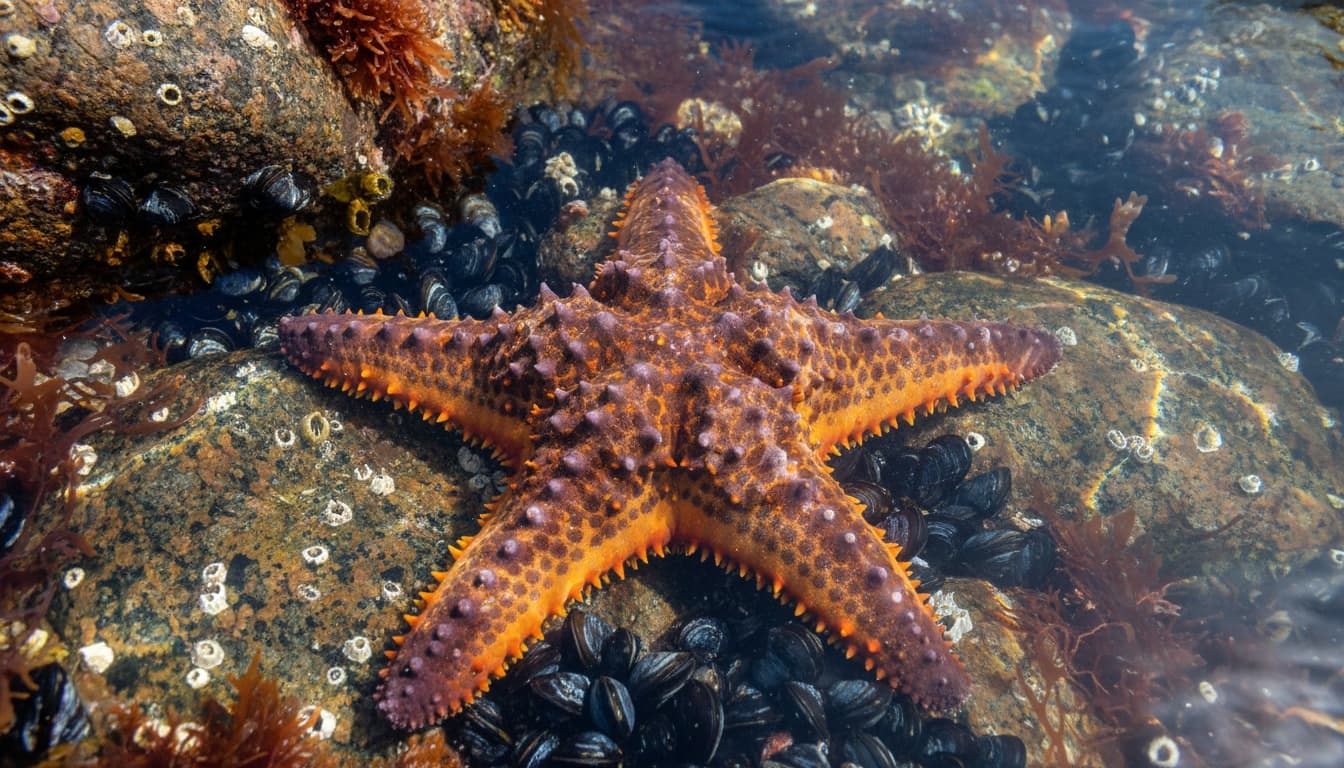
Ochre sea stars (Pisaster ochraceus) are echinoderms ranging from 10-25 cm in diameter with five stout arms. They display striking color variation from purple to orange, yellow, and brown, with smooth surfaces that distinguish them from spiny sea star species.
The ochre sea star species page goes by several names — purple sea star, ochre starfish, or scientifically as Pisaster ochraceus. Don't let the name fool you. These aren't actually fish at all.
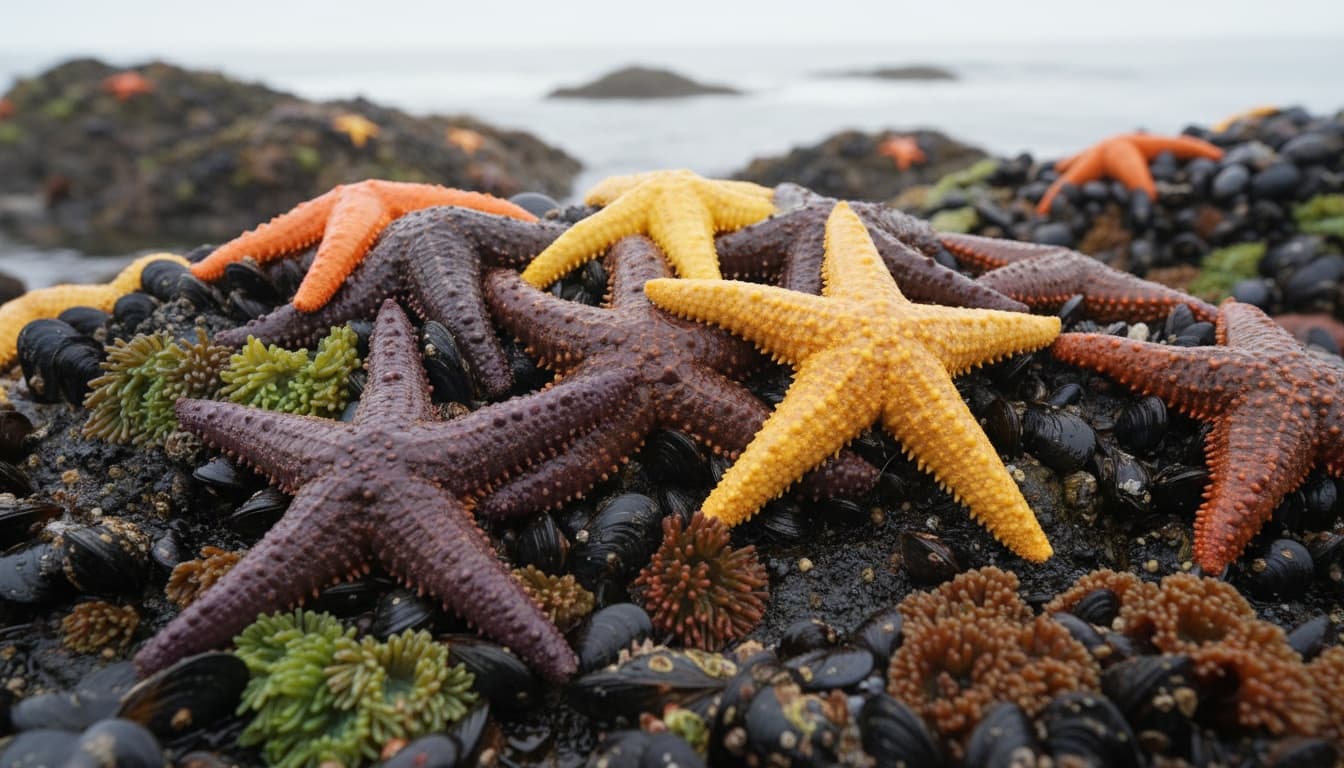
Their color variation catches your eye immediately. You'll find specimens ranging from deep purple to bright orange, yellow, and brown — sometimes all in the same tide pool.
The most common colors appear to be purple and orange, though yellow specimens stand out immediately.
Size-wise, they're impressive. Adults typically measure 10-25 centimeters (4-10 inches) in diameter, with five stout rays that can stretch up to 25 cm long. Research shows their tube feet — hundreds of tiny hydraulic cylinders — are living, breathing extensions that line each arm's underside.
What sets them apart from other Pacific sea stars: their ossicles (tiny skeletal plates) never exceed 2mm in height, creating a relatively smooth surface. Most similar species have more pronounced spines or bumps.
Distinguishing Features from Other Sea Stars
You might spot giant green anemones in the same tide pools, but ochre sea stars have a distinctive thick, muscular arm structure. Unlike the more delicate arms of other starfish, ochre sea star rays feel substantial — almost rubbery when you observe them closely.
These distinctive features make ochre sea stars relatively easy to identify in the field, especially when cross-referencing with a field guide or mobile identification tool.
Their tube feet arrangement is another giveaway. They're densely packed and strong, capable of gripping wave-battered rocks with surprising tenacity.
2. Where Do Ochre Sea Stars Live?
Ochre sea stars inhabit the Pacific Ocean from Prince William Sound, Alaska, to Point Sal, Santa Barbara County, California — roughly 2,000 miles of coastline. They thrive in wave-exposed rocky intertidal zones and subtidal depths to 90 meters.
Notably, they're endemic to this specific stretch of the Pacific. You won't find them in the Atlantic or anywhere else globally.
Their preferred habitat? Rocky intertidal zones with heavy wave exposure. They actually thrive in conditions that would pummel most marine life. The constant wave action brings fresh food and oxygen while preventing competitors from establishing nearby territories.
Tide pools serve as their hunting grounds during low tide, but they're equally at home subtidally down to depths of 90 meters. During extreme low tides, you'll often find them clustered in deeper crevices or under ledges.
3. How Do Ochre Sea Stars Hunt?
Ochre sea stars are active predators that consume up to 80 California mussels annually. They use tube feet to pry open shells, then evert their stomach externally to digest prey over 2-3 days.
These aren't passive filter feeders. Ochre sea stars are active predators with surprisingly sophisticated hunting techniques.
The Feeding Process: External Digestion
Their primary prey includes California mussels, barnacles, and purple sea urchins. One ochre sea star can consume up to 80 California mussels per year — that's more than one mussel every four days.
The feeding process is fascinating (and slightly gross if you're squeamish). They use their tube feet to pry open mussel shells, then evert their stomach through their mouth to digest the prey externally. This process can take two to three days for a large mussel.
I've watched a single ochre sea star spend three days prying open one stubborn mussel — their patience is extraordinary. Their sensory abilities border on supernatural, though the specific mechanisms aren't fully documented in available research.
Why Are Ochre Sea Stars Important?
Remove ochre sea stars from a rocky shore, and the entire ecosystem collapses within months. Mussel beds expand rapidly, crowding out barnacles, anemones, and other species that depend on open rock surface.
This keystone effect means their ecological impact far exceeds what you'd expect from their numbers alone.
4. The Keystone Predator: Why Ochre Sea Stars Matter to Ocean Ecosystems
Robert Paine's groundbreaking research in the 1960s established ochre sea stars as the original keystone species. His experiments removing them from Mukkaw Bay, Washington, demonstrated their disproportionate ecological importance.
In his experiments, mussel beds dominated 80% of available space within a year. Biodiversity plummeted as mussels outcompeted everything else for prime real estate on wave-exposed rocks.
Modern research confirms Paine's findings across the Pacific coast. Healthy ochre sea star populations maintain habitat diversity that supports numerous other intertidal species.
Cascade Effects Through the Food Web
The cascade effects ripple through multiple trophic levels:
• Ochre sea stars control mussel populations • This creates space for gooseneck barnacles, anemones, and smaller invertebrates • These, in turn, support shorebirds, crabs, and fish
Economic and Cultural Significance
Indigenous peoples of the Pacific Northwest have harvested and observed these sea stars for thousands of years. Modern tide pooling tourism generates millions in coastal revenue annually, with ochre sea stars serving as flagship species for rocky intertidal education programs.
Their role extends beyond ecology — they're living indicators of ocean health that researchers monitor for climate change impacts.
5. What Is Sea Star Wasting Disease?
Sea star wasting disease (SSWD) struck the Pacific coast between 2013-2015, causing up to 99% mortality in some locations. Symptoms include white lesions, arm loss, and body deflation. Most affected individuals die within days to weeks.
It was heartbreaking to see these ancient predators reduced to white goo in tide pools.
The mortality rates were devastating — up to 99% in some locations. All four of California's coastal regions showed population collapse between 2013 and 2014. Oregon and Washington experienced similar devastation.
Recent trend analysis indicates an 8.2% annual decline in ochre sea star populations, explaining 60% of the year-to-year variation in abundance. That's a sobering statistic for a keystone species.
The disease symptoms appear to include white lesions followed by arm loss and body deflation, though specific progression details require further research. Most affected individuals die within days to weeks based on field observations.
Climate change connections are becoming clearer through ongoing research. Warmer ocean temperatures and ocean acidification stress may make sea stars more susceptible to the disease-causing virus.
Are Ochre Sea Stars Recovering from Wasting Disease?
Recovery varies by location. Northern populations show stabilization and juvenile recruitment since 2018, while southern California populations continue declining. Some populations appear to be developing disease resistance, suggesting evolutionary adaptation.
Specific case studies from Monterey Bay show gradual juvenile recruitment since 2018, while Olympic Peninsula populations remain severely depleted. Each rocky intertidal zone tells a different recovery story.
Recent monitoring by marine biologists suggests some populations are developing disease resistance, indicating potential evolutionary adaptation in real-time.
6. How Do Ochre Sea Stars Reproduce?
Ochre sea stars reproduce sexually during May-July breeding season. A single female releases up to 40 million eggs, which males fertilize externally. Larvae drift 2.5-8 months before settling. They can also reproduce asexually through arm regeneration.
Ochre sea stars hedge their reproductive bets with both sexual and asexual strategies. Sexual reproduction dominates, with breeding season occurring between May and July in most populations.
Sexual vs Asexual Reproduction Strategies
The reproductive output is staggering. During breeding season, gonads can comprise up to 40% of the sea star's body weight. A single female releases up to 40 million eggs, which males fertilize externally in the water column.
Larvae drift with ocean currents for 2.5 to 8 months before settling and metamorphosing into juvenile sea stars. This extended larval phase allows wide dispersal but also exposes them to numerous predators.
Asexual reproduction occurs through arm regeneration. If an arm breaks off with part of the central disc, it may regenerate into a complete individual based on general sea star biology. This ability also helps them survive predator attacks and wave damage.
How Do Ochre Sea Stars Survive Waves?
Their tube feet create strong suction, allowing them to tolerate losing 30% of body weight in fluids while maintaining grip on rocks. This physiological adaptation enables survival in wave-exposed conditions that kill most marine invertebrates.
Their lifespan reaches up to 20 years in the wild — impressive longevity for an intertidal invertebrate constantly battling waves, temperature extremes, and desiccation.
Most adults I've measured range from about 10-25 centimeters, though I've found a few monsters pushing 30cm in particularly wave-exposed locations. Their tube feet create strong suction — they can tolerate losing 30% of their body weight in fluids while maintaining their grip on wave-battered rocks.
This physiological adaptation allows them to survive in conditions that would kill most marine invertebrates.
7. **The CatchRules Ochre Sea Star Field Guide:**
1. Color Check: Purple, orange, or yellow — never pink or red (those are different species) 2. Size Test: Adult diameter 4-10 inches with thick, muscular arms 3. Habitat Confirm: Wave-exposed rocky shores, not sandy beaches 4. Texture Feel: Relatively smooth surface, not spiny or bumpy 5. Behavior Watch: Active predator, often found near mussel beds
8. Where Can You Find Ochre Sea Stars?
Best viewing occurs during minus tides November-March at wave-exposed rocky shores. Prime locations include Olympic National Park, Mendocino Coast, and Monterey Peninsula. Arrive 1-2 hours before predicted low tide when they emerge from hiding spots.
Head to wave-exposed rocky shores rather than protected bays — they prefer the constant wave action.
Prime locations include Olympic National Park's coastal strip, Northern California's Mendocino Coast, and Central California's Monterey Peninsula based on their known range. Look for them in deeper crevices or under ledges.
Timing matters enormously. Arrive 1-2 hours before the predicted low tide to watch them emerge from hiding spots. They're most active during the falling tide when hunting opportunities peak.
Photography tip: their tube feet create fascinating patterns when they're moving across rocks. Capture them in action rather than just static poses.
Many tide poolers use mobile field identification tools to confirm species in real-time and check local regulations before visiting protected areas.
Always follow proper tide pool etiquette — observe without disturbing, and never remove any organisms from their habitat.
9. What Is the Conservation Status of Ochre Sea Stars?
Ochre sea stars lack formal conservation status but face ongoing population decline. Primary threats include climate change, ocean acidification, and pollution. Recovery efforts focus on monitoring, research, and habitat protection through marine protected areas.
The ongoing decline rate puts them in a precarious position for a keystone species.
Primary threats include climate change, ocean acidification, and pollution. Rising ocean temperatures may increase SSWD susceptibility, while acidification affects their calcium carbonate skeleton.
Marine protected areas provide some refuge, but the disease doesn't respect boundaries. Recovery efforts focus on monitoring, research, and habitat protection rather than direct intervention.
Citizen science programs through iNaturalist help track population recovery. Your observations contribute valuable data to researchers studying their comeback across this endemic Pacific species' range. You can view thousands of ochre sea star observations on iNaturalist and add your own sightings to help track population recovery.
The long-term outlook remains uncertain. Some populations show resilience and potential disease resistance, while others continue declining. Their recovery will likely determine the future biodiversity of Pacific rocky shores.
10. Key Takeaways
- Ochre sea stars are keystone predators controlling mussel populations across Pacific rocky shores
- Color variations from purple to orange to yellow occur naturally within populations
- Sea star wasting disease caused up to 99% mortality in some locations between 2013-2015
- Individual females can produce 40 million eggs during the May-July breeding season
- Population decline varies by region, with some areas showing promising signs of disease resistance
- Their 20-year lifespan and dual reproductive strategies demonstrate resilience
11. Frequently Asked Questions
Q: How do ochre sea stars survive in crashing waves? A: Their tube feet create strong suction — they can tolerate losing 30% of their body weight in fluids while maintaining their grip on wave-battered rocks.
Q: Can ochre sea stars regenerate lost arms? A: Yes, they regenerate lost arms over several months. If an arm breaks off with part of the central disc, it can grow into a complete new individual.
Q: What's the difference between ochre sea stars and purple sea stars? A: They're the same species (Pisaster ochraceus). "Purple sea star" and "ochre sea star" are both common names for the same animal, which displays multiple color variations.
Q: How fast do ochre sea stars move? A: They move surprisingly slowly — typically less than 6 inches per hour. Their tube feet work in coordinated waves to propel them across rocks and through tide pools.
Q: Are ochre sea star populations recovering from wasting disease? A: Recovery varies by location. Northern populations show stabilization and juvenile recruitment since 2018, while southern California populations continue declining. Monitoring continues across their range.
Q: What should I do if I find a diseased ochre sea star? A: Don't touch it — the disease may be transmissible between individuals. Report your observation to local marine biologists or through iNaturalist to help track disease patterns.
Ready to identify ochre sea stars in the field? Many tide poolers use mobile field guides to confirm species identification in real-time, especially when exploring remote tide pools without cell service. These tools also help you check local regulations and size limits before you visit.