
1. Why a Quarter-Inch Costs You: Legal Measurement Standards That Protect Your Catch
A quarter-inch. That's the margin that cost one angler a citation on a bass he was certain was legal. He'd measured it. With the mouth cracked open.
Minimum size limits protect fish before they've had a chance to spawn. Keep a bass that's a quarter-inch short and you've potentially removed a fish that hasn't reproduced yet. That's not a moral argument — it's basic fisheries biology.
Talk to any warden and they'll tell you the same thing: most citations aren't from poachers. They're from anglers who used the wrong measurement technique, or eyeballed a borderline fish and guessed wrong. Using fork length when your state requires total length can mean a fish that reads legal is actually an inch under the minimum.
State Regulations Change Annually
Florida's Fish and Wildlife Conservation Commission has long required standardized measurement definitions. The pinched-tail, closed-mouth definition of total length is codified in Florida FWC regulations — verify the current version directly with FWC. You are responsible for knowing which method applies.
Some states have updated their minimum size limits for walleye in recent years following population surveys — another reason to check current regs, not the prior season's pamphlet. Regulations continue to evolve, so always verify current rules with your state or provincial wildlife agency before fishing.
---
2. Total Length vs. Fork Length: Why Using the Wrong Method Gets You Cited
These two methods look similar on paper. The difference matters legally. On a forked-tail fish, they can differ by an inch or more.
Total length (TL): Measured from the most forward point of the snout — mouth closed — to the farthest tip of the tail with the tail fins compressed together. For most jurisdictions, it's a straight-line measure, not taken over the curve of the body. This is the default for most freshwater species across North America.
Fork length (FL): Measured from the tip of the snout (or, for some species, the anterior-most part of the lower jaw) to the center notch of the tail — the fork. Fish regulated by fork length are typically measured to the center of the fork in the tail, not the outer tips of the tail lobes. Fork length is common for saltwater and migratory species where the tail tip is hard to define cleanly.
Standard length (SL): Snout tip to the posterior end of the last vertebra, excluding the tail fin entirely. According to Wikipedia's fish measurement entry, SL is used primarily with Teleostei (most bony fish) in ichthyology and morphometric research. You won't see it in recreational fishing regulations.
→ Scroll right on mobile to see full table.
| Method | Start Point | End Point | Common Use |
|---|---|---|---|
| Total Length | Snout tip (mouth closed) | Pinched tail tip | Most freshwater regulations |
| Fork Length | Snout tip or lower jaw | Tail fork center | Many saltwater/migratory species |
| Standard Length | Snout tip | Base of tail fin (no caudal fin) | Scientific/ichthyology research |
How to Legally Measure a Fish
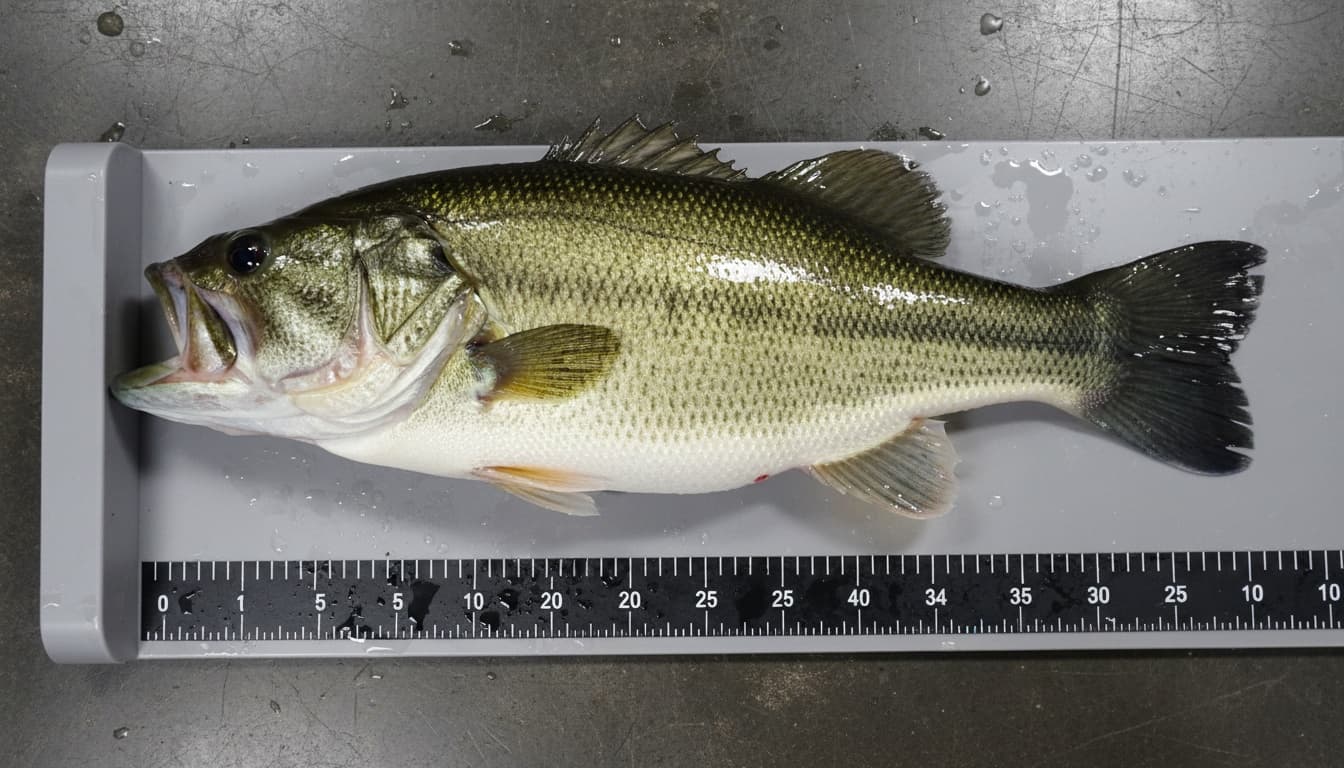
Legal measurement means using the method your regulations specify — not the one that makes your fish look biggest. For most freshwater species, that's total length with the mouth closed and the tail pinched. Place the fish on a flat surface, align the snout tip at zero, and read the tail tip. When regulations don't specify a method, default to total length.
Casual measurement is forgiving. Legal measurement is not. If you're deciding whether to keep a fish, you need the right method, the right tool, and a fish that's lying flat and still.
---
3. 7 Steps to Measure a Fish Legally (And Avoid the Mistakes That Cause Citations)
Seven steps. Do them in order. Snout to tail — that's the sequence.
Step 1: Wet your measuring surface. A dry bump board stresses the fish and damages its slime coat. Thirty seconds of water on the board matters.
Step 2: Lay the fish flat, belly down or on its side. Keep it still. A fish that's arching or flopping will give you a short read every time: the body curve eats length.
Step 3: Close the mouth fully. On a big largemouth, you may need to hold the lower jaw up — they don't cooperate. An open mouth adds real length, anywhere from half an inch to over an inch depending on species. Florida FWC's definition of total length requires a closed mouth. The closed jaw tip is your measurement starting point.
Step 4: Align the snout tip precisely at zero. Not the lip. Not the eye. The very tip of the closed jaw — snout to tail is a straight line, and it starts here. This is where most measurement errors begin.
Step 5: Read the tail. For total length, pinch the tail fins together at their longest point. How hard should you pinch? Firm enough that the tail can't splay, not so hard you're bending the fin rays. For fork length, read at the center notch of the tail.
Step 6: Record it immediately. If the fish is borderline, measure twice. Don't trust your memory on a fish that's squirming.
Step 7: Return undersized fish fast. Every second out of water costs the fish — and if you've been wrestling with a borderline measurement, that fish has already been out too long.
Borderline fish? When in doubt, release it. Rounding up is how anglers get cited.
What Tools Do You Need to Measure a Fish?
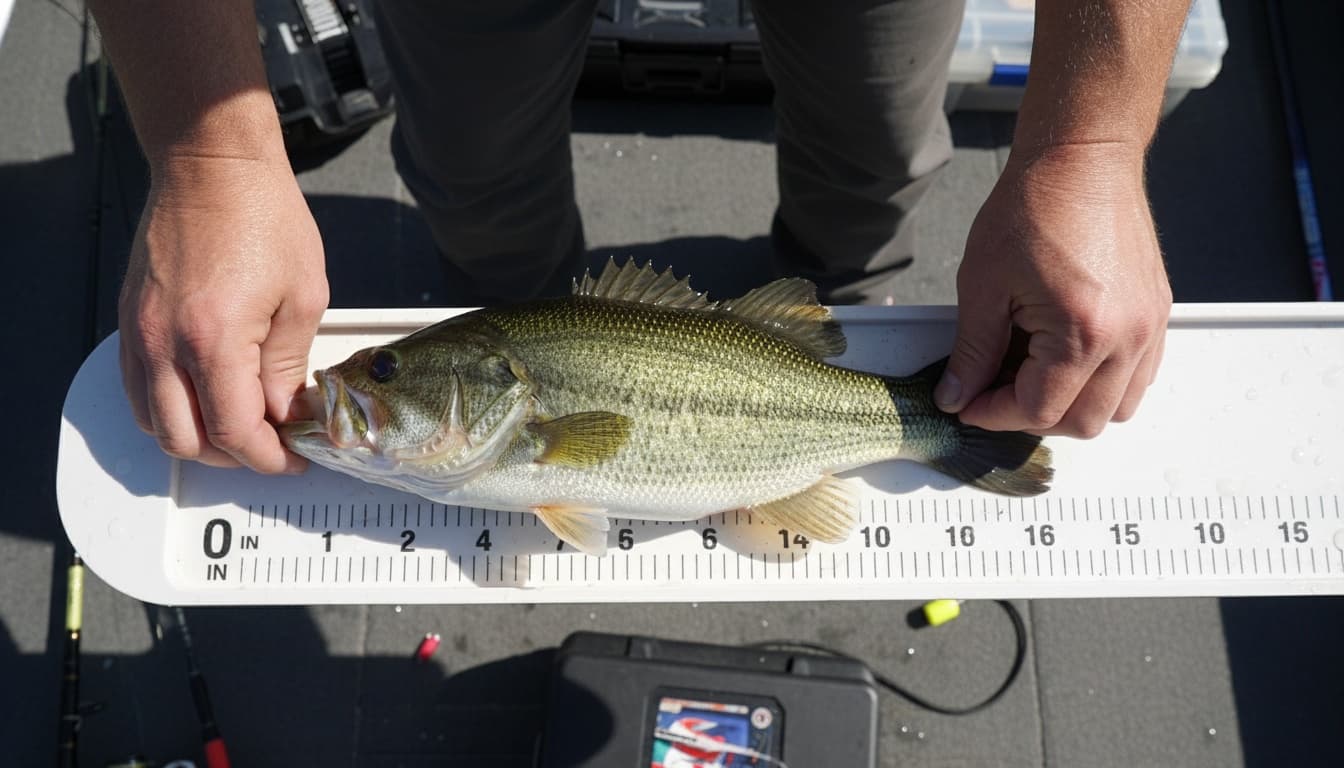
Bump boards eliminate the most common measurement error: a shifting zero point. The fixed stop means you can't accidentally start your measurement a quarter-inch off the snout tip, which is how most citations happen. Several manufacturers make boards that hold up in saltwater — verify current pricing before you buy. Verify the zero mark is intact before each season.
Flexible tape measures work on curved or large fish — useful for catch-and-release situations where you need a quick estimate without stressing the fish. Trade-off: less accurate on small fish where every eighth-inch matters for legal compliance.
Built-in rulers on tackle boxes or coolers are better than nothing. Check that the zero mark hasn't worn off.
Waterproof measuring tape stickers mounted on your kayak or cooler mean you'll never be without a measuring device. That's the second most common reason anglers eyeball borderline fish and guess wrong: they forgot their gear. One sticker, zero extra gear to carry.
---
4. Field Estimates When You Don't Have a Ruler: Quick Methods That Work (And When They Don't)
No measuring device on the water? Use your hand span (thumb to pinky, roughly 8–9 inches on most adults) or your forearm (elbow to wrist, roughly 10–12 inches). Count spans from snout to tail. These are field estimates only — not legal proof of size. Always use a physical measuring device for keep-or-release decisions.
Using Your Body as a Reference
Hand span method: Thumb tip to pinky tip on an average adult hand spans roughly 8–9 inches. Count spans along the fish's body from snout to tail.
Forearm method: Elbow to wrist runs about 10–12 inches on most adults. A fish that's "one forearm" is somewhere in that range — useful for quickly sizing panfish or small trout.
Finger width: About ¾ of an inch. Good for fine-tuning estimates when you're close to a limit.
Measure your own hand and forearm at home before your next trip. Memorize those numbers. Two minutes of prep, genuinely useful on the water.
These are estimates. Not legal proof. If you're deciding whether to keep a fish, get a real measuring device.
Phone Camera and App-Based Estimation
Lay the fish next to a known-length object — a paddle, a rod handle, a tackle box — and photograph it. You can compare proportions later and get a reasonable estimate.
A phone photo next to a paddle is more reliable than most anglers' eyeball estimates, especially for fish in the 12–18 inch range where regulations are tightest. The camera doesn't lie. Your memory does.
---
5. Why Your Bass Measurement Method Won't Work for Walleye: Species-Specific Standards
One measurement method does not fit all species. This is where anglers get into trouble — assuming that because they know how to measure a bass, they know how to measure a striper.
→ Scroll right on mobile to see full table.
| Species | Measurement Method | Verify With |
|---|---|---|
| Largemouth / Smallmouth Bass | Total length (mouth closed, tail pinched) | State fish and wildlife agency |
| Walleye | Total length (mouth closed) | State fish and wildlife agency |
| Striped Bass | Total length in most states; check federal waters separately | NOAA Fisheries for federal waters; state agency for state waters |
| Trout / Salmon | Fork length in federal waters; TL varies by state | State fish and wildlife agency |
| Bluegill / Panfish | Total length (mouth closed) | State fish and wildlife agency |
| Flounder / Flatfish | Total length (lay flat, measure straight) | State fish and wildlife agency |
| Sharks | Fork length, per federal guidance | NOAA Fisheries |
Saltwater regulations differ significantly from freshwater. Tuna, mahi-mahi, and billfish commonly use fork length under federal regulations. Always verify with your state fish and wildlife agency before keeping any fish. Regulations change annually. What was legal last season may not be legal now.
Tournament circuits often impose stricter measurement protocols than state regulations. Always verify your circuit's specific rules before competing.
Always verify with your state or provincial wildlife agency before keeping or releasing any fish.
Fish Measurement Chart: Length-to-Weight Estimates
Weight varies by species, body shape, condition, and season. A commonly used fisheries weight estimation formula is: (Girth² × Length) ÷ 800 = approximate weight in pounds, though the specific divisor can vary by source and region. Measure girth with a fabric tape at the fish's widest point. Consult your state fisheries agency's published charts for the most accurate formula for your area.
The estimates below are approximations. Fish condition varies by season and water body.
→ Scroll right on mobile to see full table.
| Species | 15 inches | 18 inches | 20 inches | 24 inches |
|---|---|---|---|---|
| Largemouth Bass | ~1.5 lbs | ~2.8 lbs | ~4.2 lbs | ~7.5 lbs |
| Walleye | ~1.0 lbs | ~1.9 lbs | ~2.9 lbs | ~5.2 lbs |
| Rainbow Trout | ~1.0 lbs | ~2.0 lbs | ~3.0 lbs | ~5.5 lbs |
| Bluegill | ~0.4 lbs | ~0.9 lbs | ~1.4 lbs | ~2.8 lbs |
These are field estimates, not verified species data. For accurate length-to-weight conversions, consult your state fisheries agency's published charts.
Inches to Centimeters Conversion
Canadian regulations and some federal waters use metric. Quick reference:
| Inches | Centimeters |
|---|---|
| 10" | 25.4 cm |
| 12" | 30.5 cm |
| 14" | 35.6 cm |
| 15" | 38.1 cm |
| 18" | 45.7 cm |
| 20" | 50.8 cm |
| 24" | 61.0 cm |
| 30" | 76.2 cm |
Always verify which unit your specific regulation uses. Don't assume.
---
6. The 7 Measurement Mistakes That Cause Citations (And How to Avoid Them)
The mistake we see most often isn't intentional cheating — it's a borderline fish measured with the mouth slightly open. The same fish, measured twice with different jaw positions, reads differently every time. The difference is real and it's consistent.
We built the CatchRules 7-Point Measurement Check after tracking the most common errors anglers report. These are the mistakes that turn a fish anglers thought was legal into a citation.
---
**The CatchRules 7-Point Measurement Check**
A structured pre-keep checklist for any fish near the size limit.
1. Mouth open during measurement. An open mouth adds ½ to 1+ inch, per Florida FWC's closed-mouth requirement for total length. Always close the jaw before you read anything.
2. Tail not pinched. A spread tail on a forked-tail species can add 1–2 inches. Pinch to the natural closed position and hold it there.
3. Fish not laid flat. A curved or arching fish reads short. Flat surface, wet board.
4. Starting at the lip instead of the snout tip. The closed jaw tip is the correct measurement starting point. The lip sits slightly behind it — and that gap costs you.
5. Wrong method for the species. Measuring fork length when regulations require total length — or vice versa — is a real mistake with real legal consequences. Check the species table above before you measure.
6. Measuring a stressed or curling fish. Wet your hands, hold the fish gently straight, and measure quickly. A fish that won't lie flat needs to go back in the water.
7. Rounding up on borderline fish. Always round down. A fish reading 13.9 inches against a 14-inch minimum is undersized. Full stop.
---
One angler told us: "I measured my bass three times before I realized I was holding the jaw open. The closed-mouth measurement was a quarter-inch shorter — would've been a citation." This is the most common error we see, and it's invisible until you know to look for it.
---
7. Difficult Measurement Scenarios
Not every fish cooperates. Large fish resist the board, damaged tails complicate the read, and catch-and-release situations require judgment calls. Here's how to handle the five scenarios that don't fit the standard steps.
Wet your hands and apply gentle pressure along the body. Don't force it. If the fish is too stressed to measure cleanly, release it. A fish you can't measure accurately is a fish you shouldn't keep.
Use a flexible tape measure alongside the board, extending from the zero stop. Have a partner hold the tape taut while you read. Alternatively, mark the tail position on the board with a finger, then measure that distance separately.
Some anglers measure large fish alongside the boat without lifting them fully out. This works for rough estimates: hold the fish parallel to a rod or paddle of known length and compare. It's not legal-grade measurement, but it's better for the fish on a clear release.
For fish with ragged-edge filaments on the tail, those pieces are included in the measurement of total length. Florida FWC guidance confirms: measure to the longest intact point.
Measure as accurately as possible using the standard method. If the fish's condition makes accurate measurement impossible, err toward release.
---
8. When Apps Help (And When They Don't): Digital Tools for Verification, Not Legal Proof
For anglers who want a digital backup to their bump board, photo-measurement apps offer another option — with real limitations worth understanding.
Photo-measurement apps use computer vision to calculate fish length by comparing proportions to a known-size reference object in the frame. Useful for tournament documentation or personal records — though not universally accepted as legal proof of size.
The honest limitation: lighting, fish position, and reference placement all affect accuracy. Some tournament circuits accept app-measured photos under specific protocols — check your circuit's rules before you rely on one.
Carry a physical bump board or tape measure as backup. Always.
How CatchRules helps: CatchRules solves the most common problem anglers face on the water: uncertainty about which measurement method applies to the species you've caught. No cell signal needed — the app works offline, so you can verify the right method (total length vs. fork length) before you make a keep-or-release call. Covers a large number of species across North American waters — check the app for the current count. See how CatchRules identifies species and applies measurement methods alongside a physical measuring device.
---
9. Key Takeaways
- Total length = snout tip to pinched tail tip, mouth closed. Default for most freshwater species.
- Fork length = snout tip to center tail notch. Required for many saltwater and migratory species.
- Standard length is a scientific measurement — not used in recreational fishing regulations.
- The seven most common measurement mistakes all come down to position: mouth, tail, and body alignment.
- No ruler? Use your hand span (≈8–9 inches) or forearm (≈10–12 inches) for field estimates only.
- Weight formulas exist, but species-specific length-to-weight charts from your state agency are more reliable.
- Regulations change annually — always verify with your state or provincial wildlife agency.
- Sign up for your state fish and wildlife agency's email alerts. Last year's pamphlet is not a legal defense.
---
10. FAQ
What Is the Correct Way to Measure a Fish for Legal Purposes?
Lay it flat, close the mouth, align the snout tip at zero, read to the pinched tail tip. That's total length — the legal standard for most North American freshwater species. For saltwater species, verify whether fork length applies with your state or provincial wildlife agency before keeping any fish.
Does It Matter If the Fish's Mouth Is Open When I Measure It?
Yes — significantly. An open mouth can add half an inch to over an inch to your reading, depending on the species. Florida FWC's definition of total length explicitly requires the mouth to be closed. This is one of the most common errors anglers make on borderline fish, and it's the error most likely to result in a citation.
What's the Difference Between Total Length and Fork Length?
Total length runs from the snout tip to the farthest tip of the tail with the tail pinched together. Fork length runs from the snout tip to the center notch of the tail. On a deeply forked tail, these two measurements can differ by an inch or more. Total length is standard for most freshwater species; fork length is required for sharks, tuna, and many saltwater species.
How Do I Measure a Fish Without a Ruler?
Use your hand span (8–9 inches) or forearm (10–12 inches) to estimate length. Count spans from snout to tail. For a photo record, lay the fish next to a known-length object and photograph it. These methods give estimates only — not legal proof of size.
How Much Does a 20-Inch Bass Weigh?
A 20-inch largemouth bass typically weighs approximately 4–5 lbs, though condition varies by season and water body. You can estimate weight using a standard fisheries formula: (Girth in inches × Girth in inches × Length in inches) ÷ 800 = approximate weight in pounds — though the specific divisor can vary by source. Measure girth at the widest point with a fabric tape. Consult your state fisheries agency's published charts for the most accurate formula for your area.
Are Fish Measuring Apps Accurate Enough for Legal Compliance?
Generally, no — not as standalone legal proof. Photo-based measurement apps can produce reliable estimates when the reference object and fish position are correct, but lighting and angle affect accuracy. Some tournament circuits accept app photos under specific protocols. For legal compliance, carry a physical bump board or tape measure. Use the app as a supplement, not a replacement.
What's the Difference Between Measuring a Fish for Fun Versus Measuring It Legally?
Casual measurement — for a photo, a personal record, or a rough size estimate — is forgiving. Legal measurement is not. For any keep-or-release decision, you need the correct method for your species, a reliable measuring device, and a fish that's lying flat and still. When the stakes are a citation, "close enough" isn't.