
Species profile
Golden Trout
Oncorhynchus aguabonita
Identify Golden Trout (Oncorhynchus aguabonita) from a photo: try it free in your browser, or get unlimited IDs, no sign-up, with the CatchRules app. Plus current fishing rules across 5 jurisdictions.
At a glance
Golden Trout (Oncorhynchus aguabonita) is a bony-fish species regulated in 5 of 66 jurisdictions tracked by CatchRules across the U.S. and Canada.
The strictest bag limit is 1 (Colorado); the most generous is 10 (Alberta).
Confirmed by 415 research-grade iNaturalist observations, with California, Alberta, and Wyoming the top jurisdictions by observation count.
Notable details
- The golden trout is California's official state freshwater fish, designated in 1947.
- They are native only to the South Fork Kern River drainage in the Sierra Nevada, living above roughly 6,900 feet elevation.
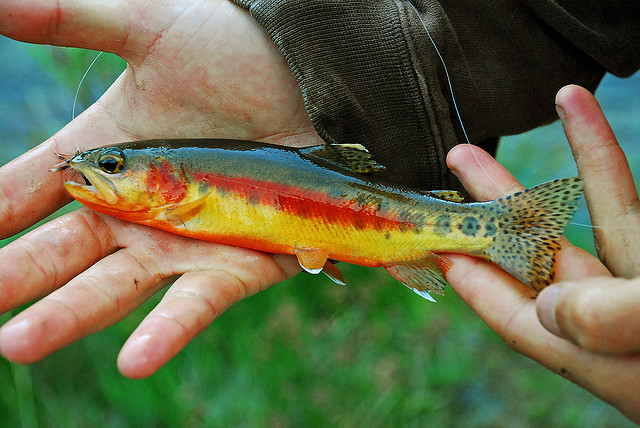
- Their vivid gold flanks, crimson lateral stripe, and spotted fins make them among the most colorful freshwater fish in North America.
- Wild golden trout rarely exceed 10 inches because cold, nutrient-poor high-altitude streams severely limit growth.
- They readily hybridize with rainbow trout, which threatens genetically pure populations throughout their native range.
Where Golden Trout are seen
Jurisdictions with rules for Golden Trout
Background
The California golden trout, or simply the golden trout (Oncorhynchus mykiss aguabonita), is a subspecies of the rainbow trout native to California. The golden trout is native to Golden Trout Creek (tributary to the Kern River), Volcano Creek (tributary to Golden Trout Creek), and the South Fork Kern River. It is the state fish of California.
Background excerpt adapted from Wikipedia's Golden Trout article (CC BY-SA). Visit Wikipedia for the full entry.
Other bony fish on CatchRules
Frequently asked questions
What is Golden Trout?
Golden Trout (Oncorhynchus aguabonita) is a bony-fish species regulated in 5 of 66 jurisdictions tracked by CatchRules across the U.S. and Canada.
What is the scientific name for Golden Trout?
Golden Trout is Oncorhynchus aguabonita.
Is Golden Trout regulated for fishing?
Yes — Golden Trout has fishing regulations in 5 U.S. states and/or Canadian provinces tracked by CatchRules. See the "Jurisdictions with rules" section above for the binding-source links.
How can I identify Golden Trout?
Take a photo with the free CatchRules app for iPhone or Android — on-device identification recognizes Golden Trout along with ~1,500 other species. No sign-up, unlimited use.
Photo credit: iNaturalist / Wikipedia. Identification reference only — verify regulations with the issuing wildlife agency before retaining a catch.