
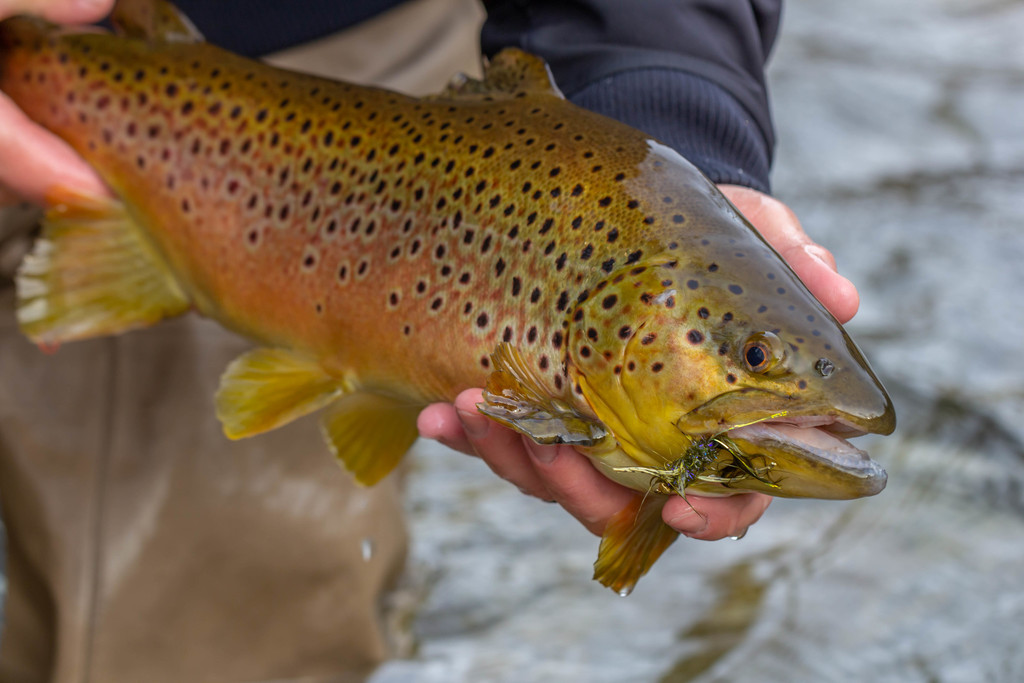
Species profile
Brown Trout
Salmo trutta
Identify Brown Trout (Salmo trutta) from a photo: try it free in your browser, or get unlimited IDs, no sign-up, with the CatchRules app. Plus current fishing rules across 50 jurisdictions.
At a glance
Brown Trout (Salmo trutta) is an IUCN Least Concern bony-fish species regulated in 44 of 66 jurisdictions tracked by CatchRules across the U.S. and Canada.
The strictest bag limit is 1 (Tennessee); the most generous is 10 (California).
Across 26 jurisdictions with stated minimum sizes, the average minimum is 15.9 in (≈ 1 ft 4 in).
Confirmed by 6,863 research-grade iNaturalist observations, with Colorado, Pennsylvania, and Utah the top jurisdictions by observation count.
Notable details
- Native to Europe, brown trout have been introduced to every continent except Antarctica.
- Both landlocked and sea-run (anadromous) forms exist within the same species.
- Adults become highly carnivorous, feeding on fish, crayfish, frogs, and even small rodents.
- Can live up to 20 years in cold, well-oxygenated streams and rivers.
- The all-tackle world record weighed over 44 lbs, caught in New Zealand.
Where Brown Trout are seen
Jurisdictions with rules for Brown Trout
Background
The brown trout (Salmo trutta) is a European species of salmonid fish that has been widely introduced into suitable environments globally. It includes both purely freshwater populations, referred to as the riverine ecotype or Salmo trutta morpha fario and a lacustrine ecotype, S. trutta morpha lacustris, also called the lake trout, as well as anadromous forms known as the sea trout, S. trutta…
Background excerpt adapted from Wikipedia's Brown Trout article (CC BY-SA). Visit Wikipedia for the full entry.
Other bony fish on CatchRules
Frequently asked questions
What is Brown Trout?
Brown Trout (Salmo trutta) is an IUCN Least Concern bony-fish species regulated in 44 of 66 jurisdictions tracked by CatchRules across the U.S. and Canada.
What is the scientific name for Brown Trout?
Brown Trout is Salmo trutta.
Is Brown Trout regulated for fishing?
Yes — Brown Trout has fishing regulations in 50 U.S. states and/or Canadian provinces tracked by CatchRules. See the "Jurisdictions with rules" section above for the binding-source links.
How can I identify Brown Trout?
Take a photo with the free CatchRules app for iPhone or Android — on-device identification recognizes Brown Trout along with ~1,500 other species. No sign-up, unlimited use.
Photo credit: iNaturalist / Wikipedia. Identification reference only — verify regulations with the issuing wildlife agency before retaining a catch.