
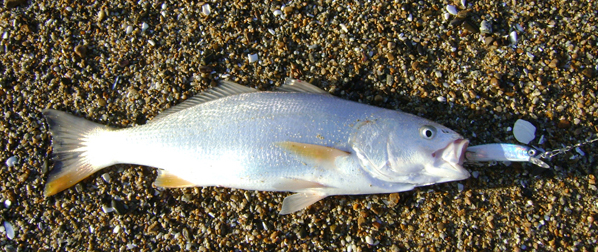
Species profile
Corvina
Cilus gilberti
Identify Corvina (Cilus gilberti) from a photo: try it free in your browser, or get unlimited IDs, no sign-up, with the CatchRules app. Plus current fishing rules across 1 jurisdiction.
At a glance
Corvina (Cilus gilberti) is an IUCN Data Deficient bony-fish species with specific harvest rules tracked in 1 of 66 jurisdictions covered by CatchRules.
Notable details
- This large drum-family fish inhabits nearshore Pacific waters off the coasts of Chile and Peru.
- Adults can approach 1 meter in length, making it an impressive sport and commercial fish.
- Like other sciaenids, it uses specialized muscles to vibrate its swim bladder and produce sound.
- Its firm, mild white flesh makes it one of South America's most prized fish for ceviche.
- It supports important commercial and artisanal fisheries along the Humboldt Current coast.
Jurisdictions with rules for Corvina
Background
The corvina, also known as the corvina drum (Cilus gilberti), is a saltwater fish of the Sciaenidae family (commonly called croakers or drums). It inhabits mostly tropical to temperate coastal waters of the southeastern Pacific along Central and South America. The corvina is highly prized in South America as a food fish.
Background excerpt adapted from Wikipedia's Corvina article (CC BY-SA). Visit Wikipedia for the full entry.
Other bony fish on CatchRules
Frequently asked questions
What is Corvina?
Corvina (Cilus gilberti) is an IUCN Data Deficient bony-fish species with specific harvest rules tracked in 1 of 66 jurisdictions covered by CatchRules.
What is the scientific name for Corvina?
Corvina is Cilus gilberti.
Is Corvina regulated for fishing?
Yes — Corvina has fishing regulations in 1 U.S. state and/or Canadian province tracked by CatchRules. See the "Jurisdictions with rules" section above for the binding-source links.
How can I identify Corvina?
Take a photo with the free CatchRules app for iPhone or Android — on-device identification recognizes Corvina along with ~1,500 other species. No sign-up, unlimited use.
Photo credit: iNaturalist / Wikipedia. Identification reference only — verify regulations with the issuing wildlife agency before retaining a catch.