
Species profile
Westslope Cutthroat Trout
Oncorhynchus lewisi
Identify Westslope Cutthroat Trout (Oncorhynchus lewisi) from a photo: try it free in your browser, or get unlimited IDs, no sign-up, with the CatchRules app. Plus current fishing rules across 3 jurisdictions.
At a glance
Westslope Cutthroat Trout (Oncorhynchus lewisi) is a bony-fish species regulated in 3 of 66 jurisdictions tracked by CatchRules across the U.S. and Canada.
The strictest bag limit is 1 (Alberta); the most generous is 5 (Alberta).
Confirmed by 1,184 research-grade iNaturalist observations, with Idaho, Alberta, and Montana the top jurisdictions by observation count.
Notable details
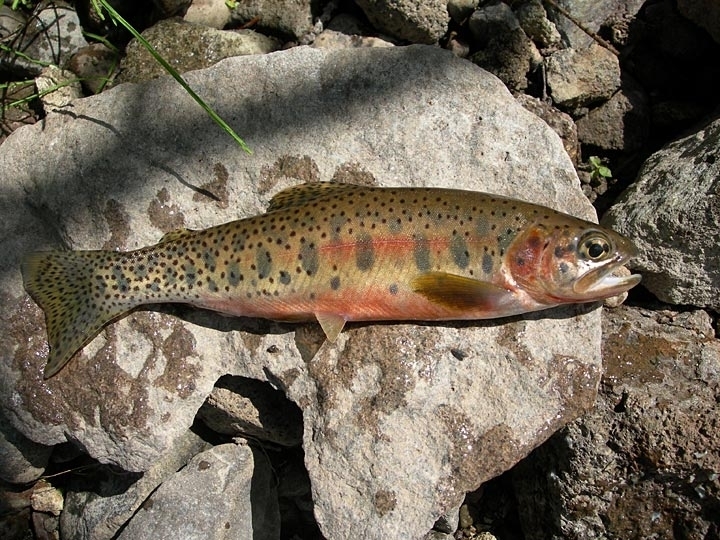
- Named for the vivid red or orange slash marks visible beneath each jaw.
- Native to the Columbia and upper Missouri River drainages of the northern Rockies.
- Typically reaches 8–14 inches in the wild, rarely exceeding 20 inches.
- Can hybridize with introduced rainbow trout, producing fertile offspring called cutbows.
- Spawns in spring over clean gravel beds in fast, cold mountain streams.
Where Westslope Cutthroat Trout are seen
Jurisdictions with rules for Westslope Cutthroat Trout
Background
The cutthroat trout is a clade of four fish species of the family Salmonidae native to cold-water tributaries of the Pacific Ocean, Rocky Mountains, and Great Basin in North America. These four species are the Coastal, Westslope, Lahontan, and the Rocky Mountain. As a member of the genus Oncorhynchus, it is in the Pacific trout group, which includes the widely distributed rainbow trout. Cutthroat…
Background excerpt adapted from Wikipedia's Westslope Cutthroat Trout article (CC BY-SA). Visit Wikipedia for the full entry.
Other bony fish on CatchRules
Frequently asked questions
What is Westslope Cutthroat Trout?
Westslope Cutthroat Trout (Oncorhynchus lewisi) is a bony-fish species regulated in 3 of 66 jurisdictions tracked by CatchRules across the U.S. and Canada.
What is the scientific name for Westslope Cutthroat Trout?
Westslope Cutthroat Trout is Oncorhynchus lewisi.
Is Westslope Cutthroat Trout regulated for fishing?
Yes — Westslope Cutthroat Trout has fishing regulations in 3 U.S. states and/or Canadian provinces tracked by CatchRules. See the "Jurisdictions with rules" section above for the binding-source links.
How can I identify Westslope Cutthroat Trout?
Take a photo with the free CatchRules app for iPhone or Android — on-device identification recognizes Westslope Cutthroat Trout along with ~1,500 other species. No sign-up, unlimited use.
Photo credit: iNaturalist / Wikipedia. Identification reference only — verify regulations with the issuing wildlife agency before retaining a catch.