
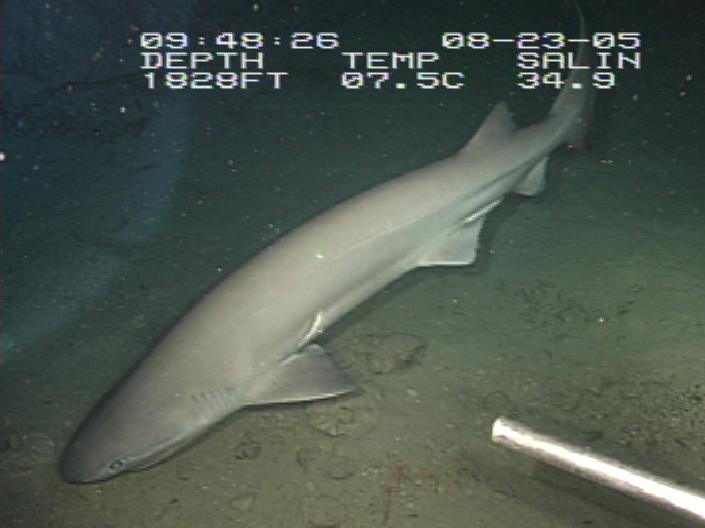
Species profile
Sixgill Shark
Hexanchus griseus
Identify Sixgill Shark (Hexanchus griseus) from a photo: try it free in your browser, or get unlimited IDs, no sign-up, with the CatchRules app. Plus current fishing rules across 6 jurisdictions.
At a glance
Sixgill Shark (Hexanchus griseus) is an IUCN Near Threatened invertebrate regulated in 7 of 66 jurisdictions tracked by CatchRules across the U.S. and Canada.
Bag limits are uniform at 1 per angler across the 2 regulating jurisdictions.
Confirmed by 35 research-grade iNaturalist observations, with Washington, British Columbia, and Oregon the top jurisdictions by observation count.
Listed under MSA and SARA — verify protected-species rules with the issuing agency before retaining or handling.
Notable details
- Unlike most sharks that have five gill slits, the sixgill has six — a primitive trait.
- Can grow to 15 feet long and weigh over 1,200 pounds.
- Regularly dives past 6,000 feet, one of the deepest ranges of any large shark.
- Its body plan has remained nearly unchanged for hundreds of millions of years.
Where Sixgill Shark are seen
Jurisdictions with rules for Sixgill Shark
Protected status
- Atlantic HMS prohibited (bluntnose sixgill) — must release unharmed.
- SARA Schedule 1 (special concern): Bluntnose Sixgill Shark. Canadian populations — harm/harvest prohibited under SARA s.32-33.
Always verify protected-species rules with the issuing agency before retaining or handling.
Background
The bluntnose sixgill shark (Hexanchus griseus), often simply called the cow shark, is the largest hexanchoid shark, growing to 26 ft (7.9 m) in length. It is found in tropical and temperate waters worldwide and its diet is widely varied by region.
Background excerpt adapted from Wikipedia's Sixgill Shark article (CC BY-SA). Visit Wikipedia for the full entry.
Other invertebrates on CatchRules
Frequently asked questions
What is Sixgill Shark?
Sixgill Shark (Hexanchus griseus) is an IUCN Near Threatened invertebrate regulated in 7 of 66 jurisdictions tracked by CatchRules across the U.S. and Canada.
What is the scientific name for Sixgill Shark?
Sixgill Shark is Hexanchus griseus.
Is Sixgill Shark regulated for fishing?
Yes — Sixgill Shark has fishing regulations in 6 U.S. states and/or Canadian provinces tracked by CatchRules. See the "Jurisdictions with rules" section above for the binding-source links.
How can I identify Sixgill Shark?
Take a photo with the free CatchRules app for iPhone or Android — on-device identification recognizes Sixgill Shark along with ~1,500 other species. No sign-up, unlimited use.
Photo credit: iNaturalist / Wikipedia. Identification reference only — verify regulations with the issuing wildlife agency before retaining a catch.