
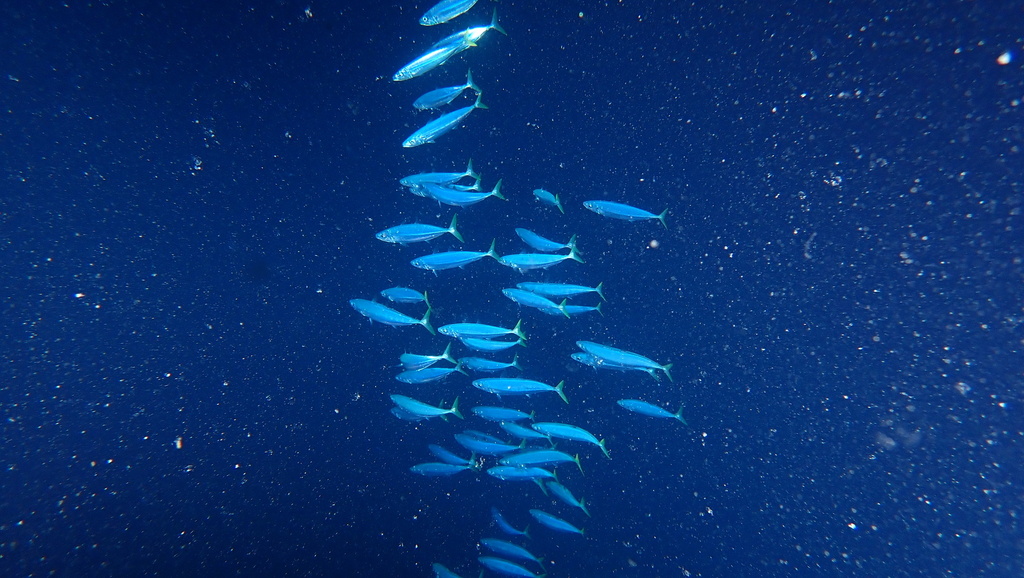
Species profile
'Opelu
Decapterus macarellus
Identify 'Opelu (Decapterus macarellus) from a photo: try it free in your browser, or get unlimited IDs, no sign-up, with the CatchRules app.
At a glance
'Opelu (Decapterus macarellus) is an IUCN Least Concern bony-fish species with specific harvest rules tracked in 1 of 66 jurisdictions covered by CatchRules.
Confirmed by 101 research-grade iNaturalist observations across the species' range.
Notable details
- Mackerel scad grow to about 12 inches and school in large numbers in Hawaiian open water.
- Hawaii's most prized live baitfish, routinely used to target blue marlin and yellowfin tuna.
- Has a row of bony scutes along the lateral line, a hallmark of the scad family.
- Eaten fresh throughout Hawaii, often pan-fried whole or sliced raw in traditional poke.
- Schools of thousands can be taken with traditional Hawaiian throw nets near shore.
Where 'Opelu are seen
Background
The mackerel scad, Decapterus macarellus, is a species of fish of the family, Carangidae. While mackerel scad can be considered gamefish, they are usually used as bait. They are popular eating fish in the Hawaiian islands, where they are called `opelu.
Background excerpt adapted from Wikipedia's 'Opelu article (CC BY-SA). Visit Wikipedia for the full entry.
Other bony fish on CatchRules
Frequently asked questions
What is 'Opelu?
'Opelu (Decapterus macarellus) is an IUCN Least Concern bony-fish species with specific harvest rules tracked in 1 of 66 jurisdictions covered by CatchRules.
What is the scientific name for 'Opelu?
'Opelu is Decapterus macarellus.
Are there fishing rules for 'Opelu?
'Opelu does not currently have published fishing rules in CatchRules' curated jurisdictions. Identification, range, and habitat are still tracked above.
How can I identify 'Opelu?
Take a photo with the free CatchRules app for iPhone or Android — on-device identification recognizes 'Opelu along with ~1,500 other species. No sign-up, unlimited use.
Photo credit: iNaturalist / Wikipedia. Identification reference only — verify regulations with the issuing wildlife agency before retaining a catch.