
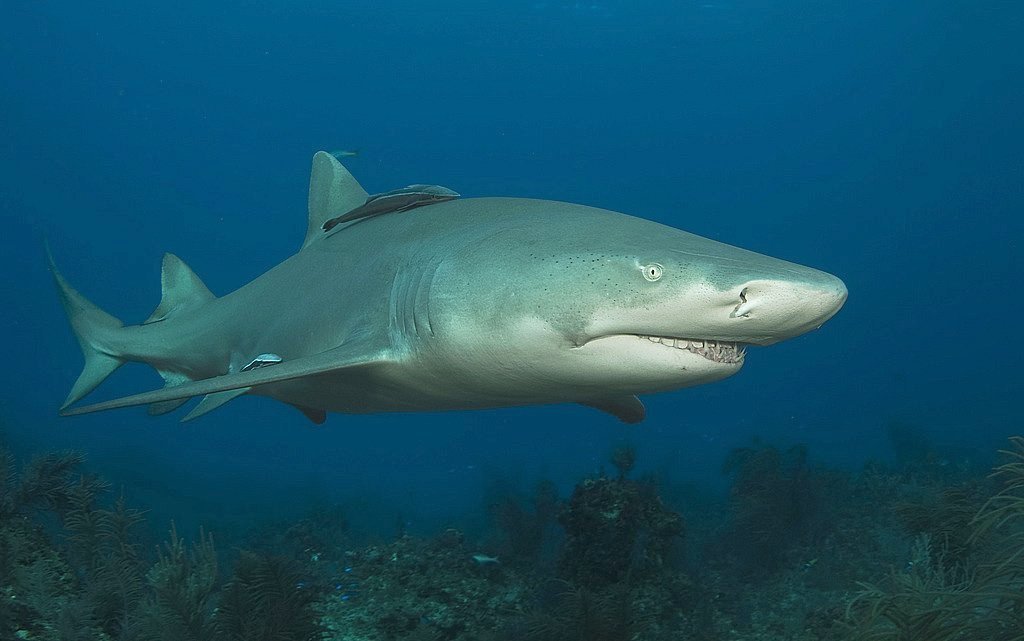
Species profile
Lemon Shark
Negaprion brevirostris
Identify Lemon Shark (Negaprion brevirostris) from a photo: try it free in your browser, or get unlimited IDs, no sign-up, with the CatchRules app. Plus current fishing rules across 4 jurisdictions.
At a glance
Lemon Shark (Negaprion brevirostris) is an IUCN Vulnerable shark or ray regulated in 5 of 66 jurisdictions tracked by CatchRules across the U.S. and Canada.
Bag limits are uniform at 1 per angler across the 5 regulating jurisdictions.
Across 4 jurisdictions with stated minimum sizes, the average minimum is 54.0 in (≈ 4 ft 6 in).
Confirmed by 386 research-grade iNaturalist observations, with Florida, Georgia, and Louisiana the top jurisdictions by observation count.
Listed under CITES — verify protected-species rules with the issuing agency before retaining or handling.
Notable details
- Named for its yellowish-tan skin, which blends with sandy seafloor habitats.
- Adults can reach 10 feet (3 m) in length and weigh over 400 pounds.
- Females return to the same shallow-water nursery where they were born to give birth.
- Young sharks spend up to 7 years in shallow mangrove nurseries before moving offshore.
- They can live approximately 25 years in the wild.
Where Lemon Shark are seen
Jurisdictions with rules for Lemon Shark
Protected status
- CITES Appendix II (Carcharhinidae — all requiem sharks, CoP19 effective Nov 2023).
Always verify protected-species rules with the issuing agency before retaining or handling.
Background
The lemon shark (Negaprion brevirostris) is a stocky and powerful shark. A member of the family Carcharhinidae, lemon sharks can grow to 3.4 metres (11 ft) in length. They are often found in shallow subtropical waters and are known to inhabit and return to specific nursery sites for breeding. Often feeding at night, these sharks use electroreceptors to find their main source of prey: fish. Lemon…
Background excerpt adapted from Wikipedia's Lemon Shark article (CC BY-SA). Visit Wikipedia for the full entry.
Other sharks & rays on CatchRules
Frequently asked questions
What is Lemon Shark?
Lemon Shark (Negaprion brevirostris) is an IUCN Vulnerable shark or ray regulated in 5 of 66 jurisdictions tracked by CatchRules across the U.S. and Canada.
What is the scientific name for Lemon Shark?
Lemon Shark is Negaprion brevirostris.
Is Lemon Shark regulated for fishing?
Yes — Lemon Shark has fishing regulations in 4 U.S. states and/or Canadian provinces tracked by CatchRules. See the "Jurisdictions with rules" section above for the binding-source links.
How can I identify Lemon Shark?
Take a photo with the free CatchRules app for iPhone or Android — on-device identification recognizes Lemon Shark along with ~1,500 other species. No sign-up, unlimited use.
Photo credit: iNaturalist / Wikipedia. Identification reference only — verify regulations with the issuing wildlife agency before retaining a catch.