
Species profile
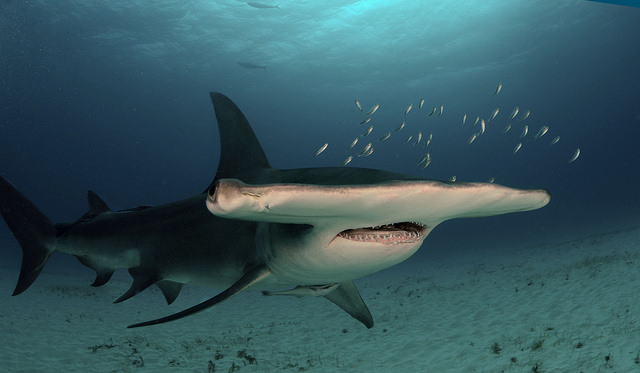
Great Hammerhead Shark
Sphyrna mokarran
Identify Great Hammerhead Shark (Sphyrna mokarran) from a photo: try it free in your browser, or get unlimited IDs, no sign-up, with the CatchRules app. Plus current fishing rules across 6 jurisdictions.
At a glance
Great Hammerhead Shark (Sphyrna mokarran) is an IUCN Critically Endangered shark or ray regulated in 7 of 66 jurisdictions tracked by CatchRules across the U.S. and Canada.
Bag limits are uniform at 1 per angler across the 6 regulating jurisdictions.
Across 5 jurisdictions with stated minimum sizes, the average minimum is 82.2 in (≈ 6 ft 10 in).
Confirmed by 67 research-grade iNaturalist observations, with Florida, Texas, and North Carolina the top jurisdictions by observation count.
Listed under CITES — verify protected-species rules with the issuing agency before retaining or handling.
Notable details
- Great hammerheads are the largest hammerhead species, reaching lengths of up to 20 feet.
- Their flattened head contains dense clusters of electroreceptors that detect prey buried in the seafloor.
- They frequently eat stingrays, and have been found with stingray barbs embedded in their mouths.
- Eyes positioned at the tips of their hammer give them nearly 360-degree vertical vision.
- Great hammerheads are listed as critically endangered by the IUCN.
Where Great Hammerhead Shark are seen
Jurisdictions with rules for Great Hammerhead Shark
Protected status
- CITES Appendix II (Sphyrnidae — all hammerheads, CoP17+CoP19).
Always verify protected-species rules with the issuing agency before retaining or handling.
Background
The great hammerhead (Sphyrna mokarran) is the largest species of hammerhead shark, belonging to the family Sphyrnidae, attaining a maximum length of 6.1 m (20 ft). It is found in tropical and warm temperate waters worldwide, inhabiting coastal areas and the continental shelf.
Background excerpt adapted from Wikipedia's Great Hammerhead Shark article (CC BY-SA). Visit Wikipedia for the full entry.
Other sharks & rays on CatchRules
Frequently asked questions
What is Great Hammerhead Shark?
Great Hammerhead Shark (Sphyrna mokarran) is an IUCN Critically Endangered shark or ray regulated in 7 of 66 jurisdictions tracked by CatchRules across the U.S. and Canada.
What is the scientific name for Great Hammerhead Shark?
Great Hammerhead Shark is Sphyrna mokarran.
Is Great Hammerhead Shark regulated for fishing?
Yes — Great Hammerhead Shark has fishing regulations in 6 U.S. states and/or Canadian provinces tracked by CatchRules. See the "Jurisdictions with rules" section above for the binding-source links.
How can I identify Great Hammerhead Shark?
Take a photo with the free CatchRules app for iPhone or Android — on-device identification recognizes Great Hammerhead Shark along with ~1,500 other species. No sign-up, unlimited use.
Photo credit: iNaturalist / Wikipedia. Identification reference only — verify regulations with the issuing wildlife agency before retaining a catch.